
OpenAI Project Daybreak? This strategic security pivot has been conclusively validated as AI pioneers pivot toward autonomous defensive agents. In May 2026, the artificial intelligence leader launched a comprehensive initiative to combat sophisticated cyber threats. Specifically, this initiative integrates frontier models with specialized agentic security tools. For developer teams navigating this volatile ecosystem shift, the immediate challenge is profound. How do we secure our software infrastructure against autonomous attacks while preventing our attribution pathways from being poisoned by sophisticated AI-generated fraud?
News & Context Breakdown
The security landscape is currently facing an unprecedented escalation. Traditional software defense mechanisms are failing to keep pace with the speed of AI-driven vulnerabilities. The OpenAI Project Daybreak initiative seeks to fundamentally rewire how enterprises build and defend software.
The Dawn of Autonomous Defense with OpenAI Project Daybreak
“Daybreak” signifies a vision for more resilient software architectures. It operates on the premise that next-generation defense must be integrated at the development stage. OpenAI is deploying frontier models to cross-reference codebases, identify latent vulnerabilities, and autonomously validate patches. However, these powerful capabilities are dual-use. Consequently, OpenAI has implemented strict identity verification and audit mechanisms to ensure these defensive tools are not weaponized by malicious actors.
Collaboration and Deployment of OpenAI Project Daybreak
The initiative functions through a specialized agentic harness known as Codex Security. Unlike traditional scanners, it maps entire repositories to create realistic threat models. Furthermore, OpenAI has already onboarded industry heavyweights like Cloudflare, Cisco, and CrowdStrike to pressure-test the ecosystem. More operational details are available in the official OpenAI project announcement.
Three-Tiered Defensive Strategy
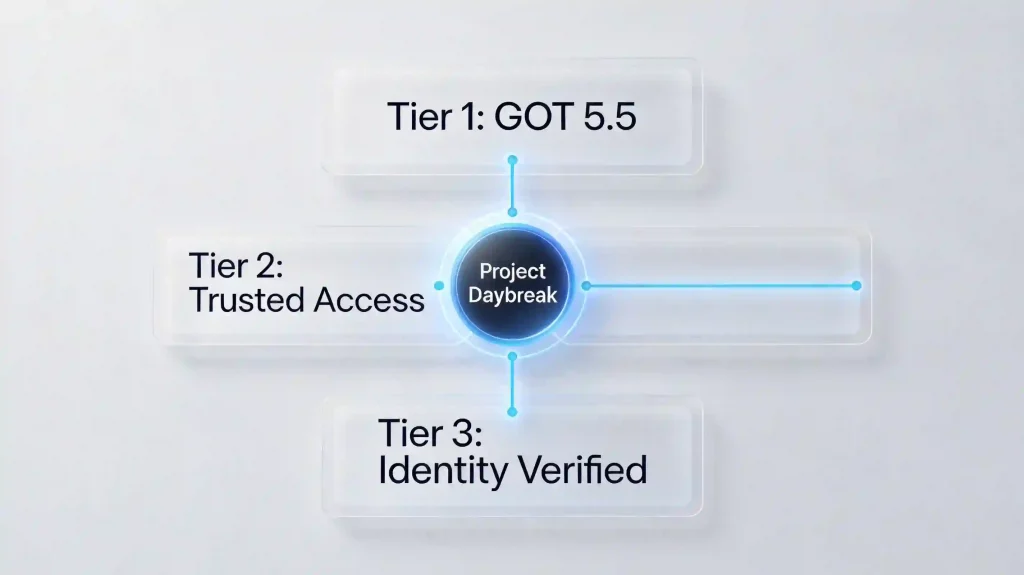
OpenAI structured OpenAI Project Daybreak across three distinct tiers. First, the GOT 5.5 layer serves general developers. Second, a trusted access tier handles complex malware and vulnerability analysis. Finally, a highly restricted, identity-verified tier provides advanced defensive modeling. This tiered approach aims to balance accessibility for the broader developer community with necessary safety guards for critical infrastructure.
The Attribution Crisis and AI Fraud Risks
While OpenAI focuses on hardening software code, Growth and Product teams face a related crisis: the poisoning of the user acquisition funnel. The same advancements that make OpenAI Project Daybreak effective are being exploited by black-hat operations to create synthetic, AI-generated fraud.
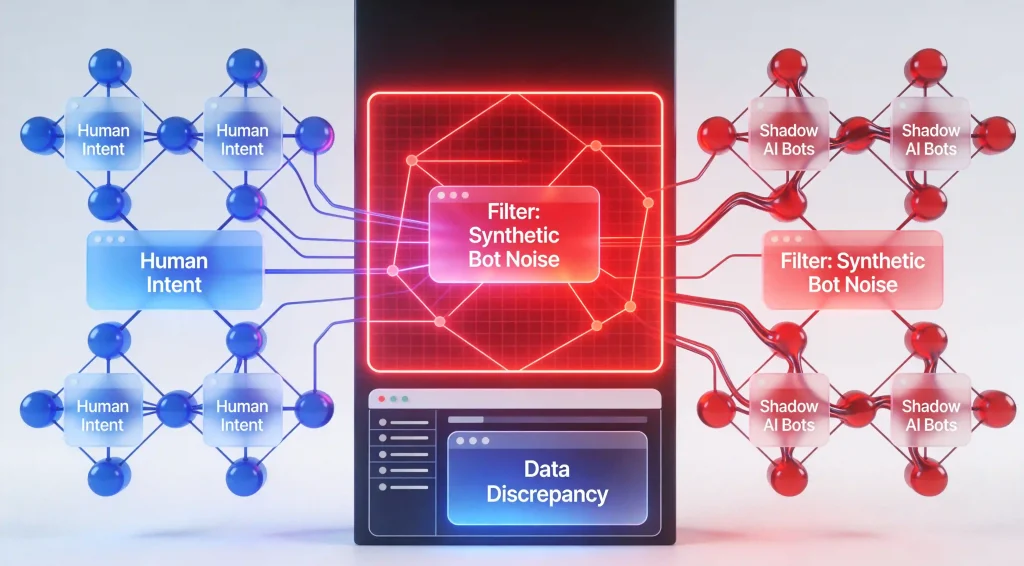
Autonomous agents can now spoof human interactions with terrifying precision. When these “Shadow AI” agents interact with digital marketing campaigns, they create a massive traffic bubble. Traditional tracking systems, built for human behavior, fail to differentiate between a real user and a bot running a sophisticated script. Developers suffer from a critical parameter loss. They cannot accurately attribute conversions to genuine human intent. This data discrepancy creates a false sense of success while simultaneously draining marketing budgets on fake installs.
Engineering Practice: Rebuilding High-Value Growth Engines
To survive this era of AI-driven vulnerability, apps must abandon spray-and-pray marketing and deploy resilient security and attribution architectures.
Problem: Autonomous AI bots effectively spoof legitimate traffic, leading to extreme parameter loss and fraudulent conversions. This destroys the accuracy of ad performance metrics and inflates Customer Acquisition Cost (CAC).
Practice: Engineering and growth teams must implement sophisticated, closed-loop identification mechanisms. By utilizing openinstall global’s Anti-Fraud and Ad Performance infrastructure, developers can embed persistent, non-spoofable security parameters directly into their deep linking architecture. When an interaction occurs, the engine instantly validates the device signature and checks for anomalous behavior patterns. It authenticates the digital fingerprint before routing the user. This safely strips away bot traffic and ensures only genuine human intent reaches the conversion milestone.
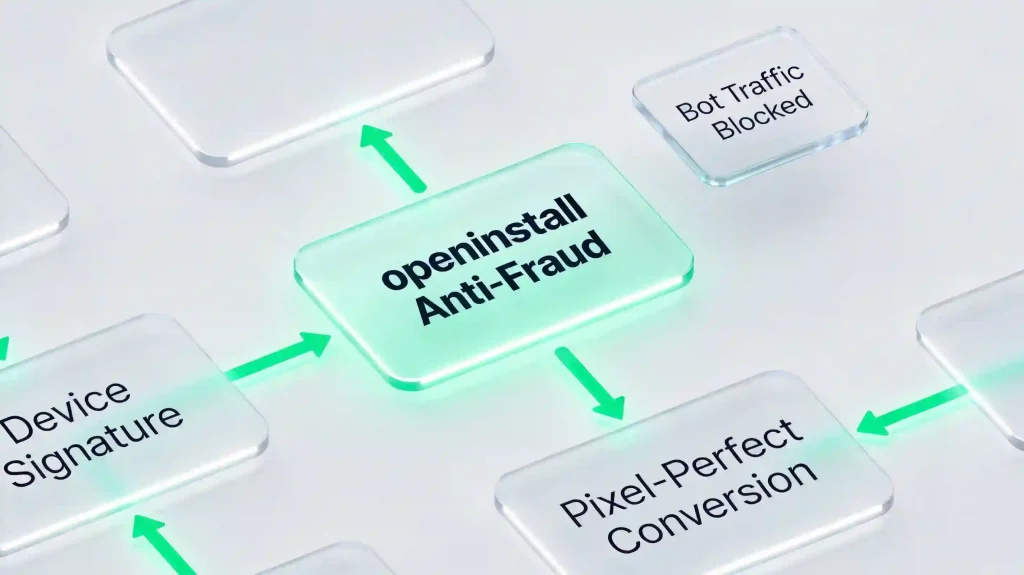
Benefit: This approach eliminates the attribution blind spot. It guarantees pixel-perfect conversion tracking, protecting the marketing budget from automated fraud. Furthermore, it enables developers to maintain a clean, high-LTV user base, securing their position despite the broader ecosystem volatility.
Industry Forward-looking Note: Regarding cross-device parameter passing for autonomous intent-driven traffic initiated by advanced agents, openinstall’s tech lab is currently conducting joint exploratory research with leading enterprise App partners.
Impact on Dev & Growth Teams
For Developers/Architecture: The integration of highly capable AI defensive tools requires robust API endpoint preparation. Developers must handle automated security validation requests seamlessly. They must optimize ID mapping strategies to maintain session continuity and accurately identify unique users. Additionally, engineers must implement strict signature verification. This crucial step prevents AI bots from exploiting vulnerabilities in the attribution chain.
For Product & Growth: Growth leads must aggressively redefine their core acquisition models. Relying on outdated click-fraud-prone metrics is no longer viable. Budget strategies require real-time optimization focused strictly on verified, human-centric campaigns. Product managers must prioritize contextual restoration, ensuring the mobile onboarding flow perfectly honors the user’s original intent while filtering out synthetic bot noise.
Frequently Asked Questions (FAQ)
What does the launch of OpenAI Project Daybreak mean for software security?
It marks a strategic pivot toward autonomous defensive agents. OpenAI Project Daybreak integrates frontier models to prioritize high-impact threats, automate vulnerability patching, and generate audit-ready evidence for developers to verify software resilience.
Why is OpenAI Project Daybreak considered a response to rising fraud risks?
The project addresses the lag between vulnerability detection and patching, which attackers are already exploiting using AI. By using specialized models to harden code from the start, OpenAI aims to neutralize threats before they can be weaponized in automated attacks.
How should developers protect their app growth from AI-driven fraud?
Developers must deploy specialized anti-fraud infrastructure that verifies device signatures and behavior patterns. Relying on traditional click-tracking is insufficient when autonomous bots can mimic human navigation; deep linking with integrated security checks is now essential to ensure accurate conversion attribution.
Industry Observations
The launch of OpenAI Project Daybreak serves as a stark warning to the entire tech industry. It confirms that the next generation of cybersecurity will be entirely automated and AI-driven. As frontier models become capable of both finding vulnerabilities and generating defenses, the speed of threat remediation will determine the survival of digital platforms.
For the broader digital ecosystem, this shift dictates entirely new rules of engagement. The competitive moat is no longer tied to legacy security vendors. Instead, it relies entirely on the autonomous defensive infrastructure that secures the underlying software code and traffic flows. Applications that fail to integrate real-time anti-fraud and resilient attribution tracking will inevitably be paralyzed by AI-generated bot fraud. Moving forward, the ability to protect human-centric user journeys from autonomous digital manipulation will define the winners in this era of relentless ecosystem restructuring.