
Microsoft Pauses Vibe Coding? This massive capital correction has been conclusively validated across the tech enterprise sector as enterprise giants rein in unconstrained computing outlays. In May 2026, tech infrastructure realities caught up with pure algorithmic enthusiasm when internal engineering teams abruptly lost their extended workspace integrations. Specifically, a profound structural shift is rewriting the financial playbook for scalable software development, forcing growth architects to look beyond heavily subsidized computational frameworks. For modern organizations caught in this sudden computational recalibration, the immediate challenge shifts from automated production to organic retention. Consequently, the industry is witnessing an ideological pivot where business logic confronts an overinflated traffic bubble.
News & Context Breakdown: The Reality Behind Why Microsoft Pauses Vibe Coding
The sudden operational realignment inside major corporate workspaces signals a profound shift in standard developer workflows. For months, enterprise software giants pushed natural language automation as the absolute future of production. However, raw computational overhead has introduced a severe financial bottleneck.
The Fiscal Deadline and the Internal Disruption
On May 14, 2026, executive leadership at Redmond quietly circulated an internal memorandum that immediately restricted developer access to autonomous external programming assistants. Specifically, the corporation began stripping the license authorization for advanced coding agents from thousands of internal environments. Management set a hard termination deadline for June 30, 2026, matching the final day of the corporate fiscal year. Crucially, this policy rollback heavily disrupted the Experiences and Devices division, the core unit responsible for engineering Windows, Microsoft 365, Outlook, Teams, and Surface hardware. Executive Vice President Rajesh Jha framed the decision under the corporate euphemism of toolchain unification. Meanwhile, authentic internal logs leaked to The Verge tech reports highlighted a much more direct motive. Engineers overwhelmingly favored the external agentic interface over native solutions, causing an organizational crisis as proprietary internal developer tools sat completely abandoned.

Budget Collapses Across the Corporate Landscape
The fiscal friction of unconstrained algorithmic development extends far beyond a single enterprise. For instance, ride-sharing titan Uber experienced a parallel financial collapse within its technical branches. Chief Technology Officer Praveen Neppalli Naga revealed to industry financial networks that Uber exhausted its entire 2026 annual AI development budget in less than four months. Uber had previously deployed gamified internal leaderboards to aggressively incentivize automated software production among its staff. This unmonitored usage triggered an immediate breakdown of their financial limits. Concurrently, hardware manufacturing executives are issuing similar warnings regarding the cost-to-benefit ratio of autonomous tools. Bryan Catanzaro, the Vice President of Applied Deep Learning at Nvidia, stated bluntly that the physical infrastructure costs of automated token consumption now completely exceed the base salaries of human engineers. This represents an astonishing admission from an executive whose parent firm dominates the global production of algorithmic hardware accelerators.

The Structural Failure of the Copilot Pricing Model
To understand why Microsoft Pauses Vibe Coding, organizations must dissect the mechanics of modern software generation. Former OpenAI researcher Andrej Karpathy defined this automation wave as an environment where developers merely dictate high-level intent in natural language. The underlying system interprets the prompt, writes the structural logic, and delivers a completed script. The human operator never reads the underlying code; they simply run the application, note errors, and instruct the machine to try again.
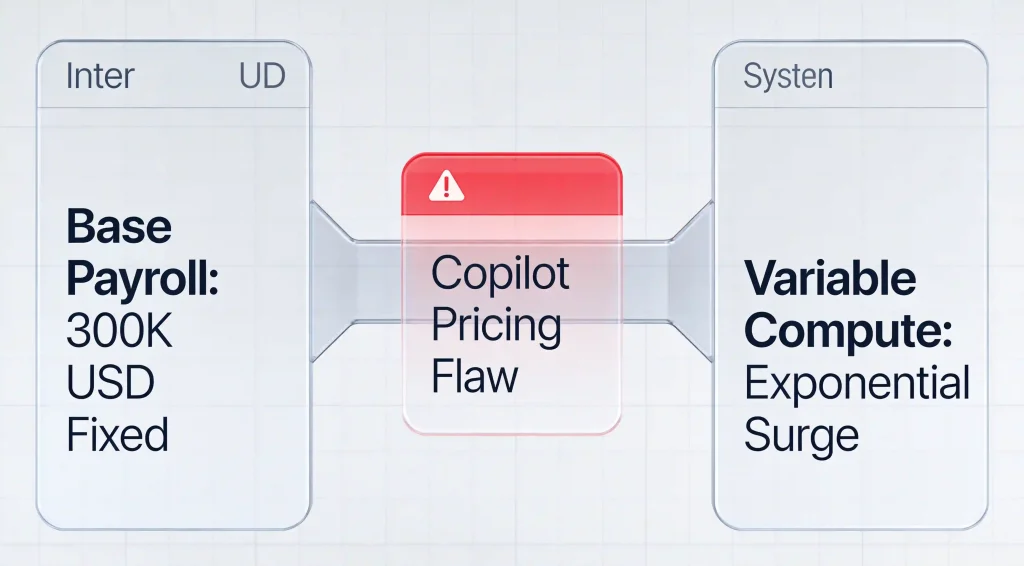
Within large enterprise frameworks, this specific copilot mode exposes a catastrophic flaw in the baseline corporate cost structure. Consider a standardized corporate scenario where a senior developer commands a baseline annual compensation package of 300,000 USD. Equipping this worker with an automated assistant may boost physical code output by approximately 20 percent. However, as the employee becomes increasingly dependent on natural language abstraction, their monthly usage bill climbs exponentially from 200 USD to over 2,000 USD. Crucially, the enterprise maintains its full original payroll obligations while stacking an un-capped, variable computational bill on top. Furthermore, an increase in raw code volume does not automatically translate to a direct spike in enterprise revenue. Writing software faster yields zero financial return if the market demand remains static.
The Attribution Crisis: Traffic Bubble Dynamics and Decoupled Growth
The broader enterprise pushback against unconstrained computing bills uncovers a deep operational truth. The digital market is confronting a profound attribution crisis. For over a year, Venture Capital firms inflated a massive traffic bubble by funding startups that burned capital to generate artificial vanity metrics.
While established corporations collide with these financial realities, decentralized startup environments are aggressively redefining corporate valuation metrics. During a recent closed-door speech hosted by Y Combinator, partner Tom Blomfield challenged founders with an aggressive counter-narrative, declaring that if an API bill does not actively cause financial pain, the startup is simply not executing fast enough. This ideological divergence occurs because early-stage firms are using automated infrastructure for total human substitution, rather than safe assistance. Y Combinator data architect Diana Hu emphasized that an agile developer leveraging specialized scripting layers now possesses the raw output capacity of an entire legacy engineering division. Emerging startups in the 2026 spring cohort are scaling to millions in transactional volume using teams of fewer than six individuals.
This structural bifurcation redefines how corporate assets are evaluated. Traditional financial ledgers calculate human headcount as a pure expense, while classifying intellectual property as a static asset. Blomfield notes that in an automated ecosystem, human presence is fleeting, whereas unified context documentation remains permanent. Native digital organizations are actively extracting knowledge from human staff and turning it into structured repositories. When operational intelligence lives inside accessible system documentations rather than transient human minds, the actual lifetime value of the business stabilizes. However, traditional analytics pipelines are completely unequipped to track this non-linear value creation. When transactions and service queries migrate to background automated networks, legacy tracking models fail, leaving growth teams completely blind to user retention origins.

Engineering Practice: Restructuring Organic User Loops After Microsoft Pauses Vibe Coding
To achieve structural resilience as the wider traffic bubble undergoes a correction, digital engineering teams must abandon volatile paid discovery channels. They must deploy self-contained, high-fidelity tracking architectures.
Restructuring User Acquisition via Referral Tracking
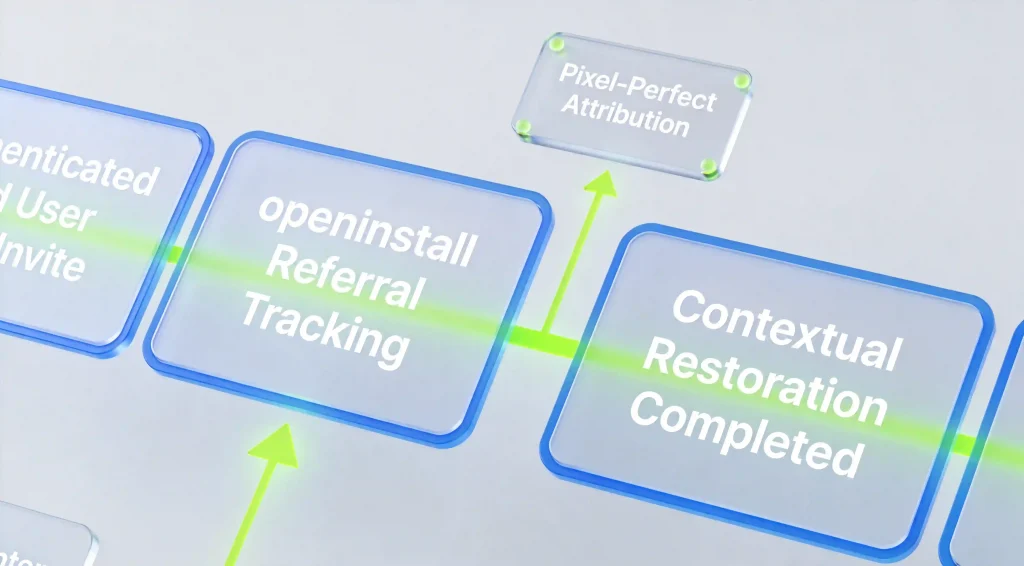
Organizations must pivot their acquisition budgets away from unpredictable programmatic ad exchanges. Instead, they must construct authenticated, incentivized user invitation loops that function independently of browser cookies. By integrating a native Referral Tracking software architecture, growth engineering teams can seamlessly bind unique user identities to custom deep linking tokens. This mechanism strips away the dependency on manual promotional codes. When a trusted brand advocate shares a contextual link, the deep linking engine instantly maps the user journey across fragmented platform interfaces, capturing the complete path from initial invite to download.
Contextual Restoration for Fractured Digital Funnels
To maximize down-funnel conversion rates, applications must minimize onboarding friction. When a prospective user transitions from a mobile web interface into a native environment, standard routing frequently drops the historical parameter payload. Growth teams can counter this drop-off by deploying an advanced deep linking engine that guarantees absolute contextual restoration. The system automatically preserves the original source parameters across the app store redirection wall. Consequently, when the app launches for the first time, it instantly customizes the user experience based on the exact referral origin, driving engagement metrics upward while reducing initial churn.
Industry Forward-looking Note: Regarding cross-device parameter transmission for background automated tasks, openinstall’s tech lab is currently conducting joint exploratory research with leading global mobile platform partners to map persistent session continuity without human interface dependencies.
Impact on Dev & Growth Teams
Technical Architecture and Data Schema Resiliency
Engineering leads must decouple internal database schemas from shifting vendor integrations. As the marketplace transitions between competing large language models, the underlying application logic must remain entirely agnostic. Furthermore, security architectures must implement mandatory signature verification protocols across all data transmission endpoints. This prevents automated bot frameworks from mimicking human navigation patterns and flooding conversion logs with synthetic event data.
Growth Optimization and Capital Efficiency Strategies
Growth marketing executives must aggressively recalibrate their evaluation of campaign effectiveness. Measuring basic upfront click-through metrics is completely non-viable in an ecosystem flooded with automated script generation. Budget optimization models must isolate high-LTV cohorts by tracking true down-funnel retention metrics. Furthermore, product teams must design completely frictionless conversion paths that focus heavily on contextual personalization, ensuring that marketing spend directly impacts real human engagement.
Frequently Asked Questions (FAQ)
Why exactly did Microsoft remove specific product permissions from internal developer workspaces?
The operational rollback occurred because unmonitored computational consumption drove infrastructure costs past acceptable financial boundaries. Additionally, the extreme popularity of the external agentic tool caused internal resource displacement, leaving native enterprise assistant suites underutilized.
How does the computing cost surge affect mid-sized application development teams?
Mid-sized organizations face an immediate cost crisis if they try to deploy AI tools as simple add-ons to an existing staff structure. Without structural organization changes, the variable computing bills quickly outpace any marginal gains in code production speed, destroying overall operational margins.
What methods secure tracking precision when traditional web pathways collapse?
Development teams must drop brittle, cookie-reliant analytics tools. They must transition to device-fingerprint-free attribution engines that utilize persistent parameters embedded directly inside advanced deep linking networks, securing reliable attribution metrics across all platform boundaries.
Industry Observations: Strategic Realities After Microsoft Pauses Vibe Coding
The decision surrounding why Microsoft Pauses Vibe Coding represents a necessary structural correction for the digital economy. The initial, naive expectation that advanced automation could be seamlessly stacked onto legacy corporate hierarchies without financial consequence has officially hit a wall. Programmatic token consumption is inherently volatile. It behaves as a resource-intensive utility that expands alongside user dependency, making it an unsustainable burden for traditional multi-layered organizations.
Moving forward, commercial dominance belongs exclusively to organizations that can ruthlessly align their cost models with actual output value. The true victory of the automation era will not be claimed by firms that simply accelerate raw, unvalidated text production. Instead, it will be defined by agile, data-centric teams that utilize precise attribution frameworks and secure deeply integrated deep link systems to preserve human intent across an increasingly complex digital landscape.