
Qualcomm Bytedance ASIC Deal? This hardware-driven structural realignment has been conclusively validated across global silicon networks as social media pioneers transition away from generalized cloud dependencies to establish decentralized edge computing fabrics. In May 2026, the global semiconductor architecture shifted decisively when leaked procurement logs exposed a massive custom chip order meant to scale deep agentic workflows across millions of devices. Specifically, this infrastructure explosion introduces an immediate distribution shift that re-maps how mobile application data moves from specialized hardware layers to localized consumer endpoints. Consequently, growth architects must rapidly adapt to an environment where user interactions are no longer captured by traditional, screen-bound click paths but are instead driven by deep system-level hardware integrations.
News & Context Breakdown: The Reality of the Qualcomm Bytedance ASIC Deal
The sudden operational realignment inside major corporate workspaces signals a profound shift in standard developer workflows. For months, enterprise software giants pushed natural language automation as the absolute future of production. However, raw computational overhead has introduced a severe financial bottleneck.
The Multi-Million Unit Silicon Procurement
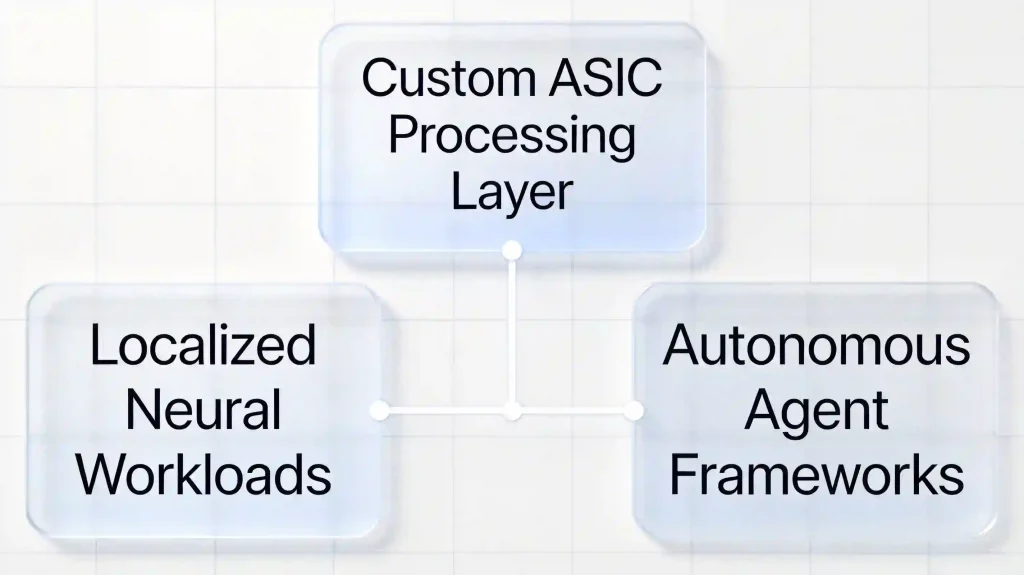
On May 26, 2026, Bloomberg exposed a private semiconductor agreement that permanently disrupts the global data center ecosystem. Specifically, ByteDance finalized an extensive contract to procure millions of custom artificial intelligence application-specific integrated circuits (ASICs) directly from Qualcomm. This historic transaction allows ByteDance to convert its completed proprietary internal chip designs into production-ready silicon ready for immediate deployment. Crucially, the custom chips will serve as the primary processing layer for ByteDance’s expanding matrix of intelligent applications and background AI agent software frameworks.
Market Reaction and Financial Surges
The revelation of this massive procurement triggered immediate volatility across international public markets. For instance, Qualcomm equity valuation surged by over 8 percent during intraday trading on Tuesday, ultimately settling at an all-time record closing price of 249.90 USD per share, representing a net single-day gain of 4.93 percent. Industry financial analysts noted that this transaction proves Qualcomm can successfully scale its ASIC design service operations to meet the rigorous demands of hyper-scale cloud operators. Furthermore, supply chain intelligence confirms that the production allocation for these multi-million unit batches will be handled by TSMC via its advanced manufacturing nodes.
The Massive 200 Billion Yuan Infrastructure Expansion
此硬件方面的长线采购直接对应了社交巨头确立全盘智能转型的基础战略布局。 Specifically, reports from the South China Morning Post reveal that ByteDance expanded its annual infrastructure budget by 25 percent for 2026, bringing its total internal computing expenditure to an unprecedented 200 billion RMB (approximately 29.4 billion USD). Meanwhile, this massive capital layout is designed to sustain the rapid growth of its core consumer offerings, such as the Doubao app, which maintained its position as the most downloaded generative AI application across Chinese app stores throughout the preceding year.
Strategic Diversification and the Battle for the Data Center
For Qualcomm, securing this massive contract validates its long-term corporate diversification roadmap away from a saturated smartphone processor market. Historically, the company maintained heavy revenue reliance on mobile handset modems, but it is now actively targeting the high-margin enterprise data center space currently dominated by Nvidia’s general-purpose graphics processing units. ASIC architectures offer unique cost control advantages and localized efficiency gains for specialized neural workloads compared to generic computing blocks. Consequently, this transaction allows Qualcomm to challenge the market share of established tech titans like Broadcom, AMD, and Google.
The Distribution Shift: Fractured Funnels After the Qualcomm Bytedance ASIC Deal
The shift from traditional mobile web interfaces to specialized edge ASICs creates a severe distribution shift that completely shatters the legacy concept of a user journey. Historically, user acquisition relied heavily on active web traffic. Consumers viewed a promotional banner, executed a distinct digital click, navigated to a web landing page, and eventually triggered an installation inside a native application.
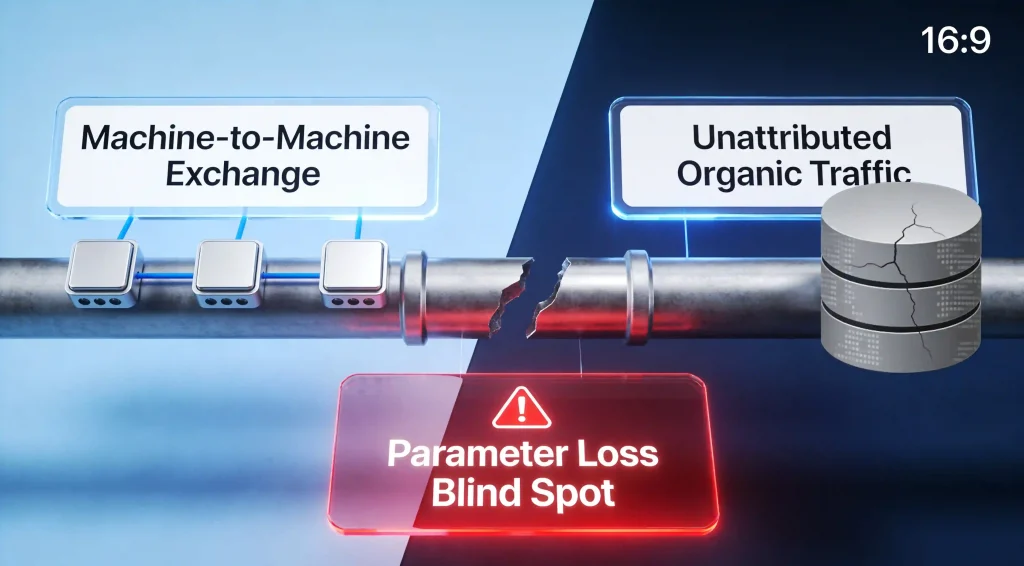
The widespread deployment of specialized hardware blocks radically fragments this linear user onboarding pipeline. Instead of interacting with visual user interfaces, consumers dictate intent to local agents running on custom device silicon. These autonomous systems parse the command, browse background data streams, and complete actions across third-party networks without requiring real-time manual confirmation. Specifically, when an autonomous system downloads data, creates a profile, or completes a transactional process on behalf of a user, standard web cookies and session tokens are completely lost.
Consequently, development teams experience an immediate attribution crisis characterized by severe parameter loss. Because the transaction occurs in a machine-to-machine exchange without a traditional link click, standard analytics tools report the incoming engagement as completely unattributed traffic. This structural data discrepancy leaves growth teams entirely blind, destroying the accuracy of basic conversion rate tracking and rendering legacy marketing calculations completely obsolete.
Engineering Practice: Restructuring Application Links for Agentic Flows
To maintain operational viability in a landscape reshaped by decentralized hardware execution, engineering teams must abandon single-platform tracking links and implement resilient cross-device data layers.
Resolving Parameter Loss with Advanced Deferred Deep Linking
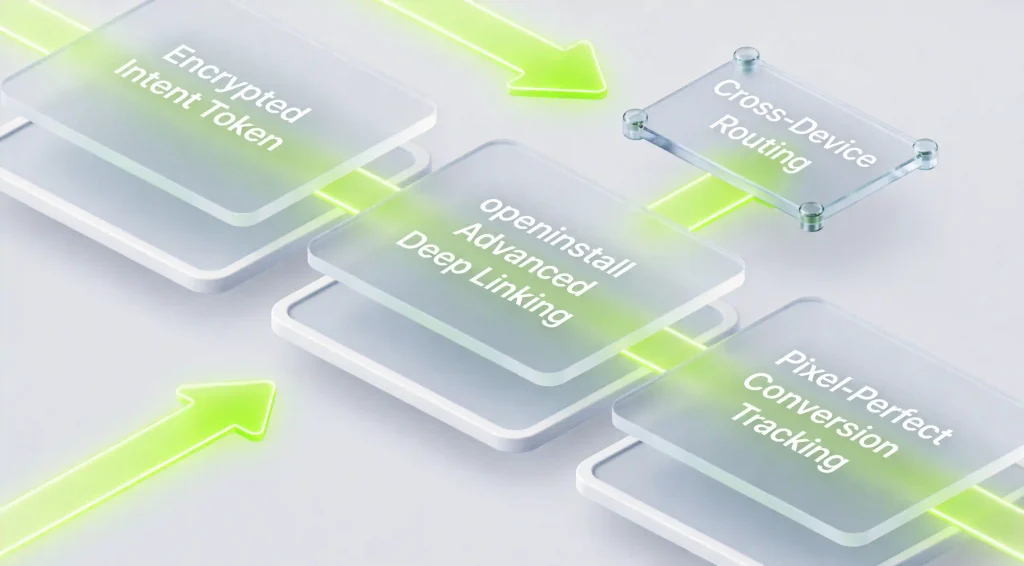
Modern development teams can bypass OS-level fragmentation by integrating specialized deferred deep linking infrastructure to capture agent-initiated context. Specifically, when a background agent triggers an interaction across decoupled hardware environments, the underlying system passes an encrypted intent token down to the deep linking engine. This protocol ensures that even if the consumer does not possess the target application locally, the core parameter payload survives the app store redirection sequence intact. For instance, once the application installs, the engine automatically extracts the source parameter, enabling perfect cross-device routing and precise conversion tracking.
Achieving Universal Reach Across Fragmented Ecosystems
Growth leads must deploy highly adaptive data routing frameworks that maintain functionality across iOS, Android, and desktop ecosystems seamlessly. Furthermore, by linking localized device parameters to a centralized attribution matrix, the business can accurately trace multi-touch conversions driven by autonomous background tasks. This framework secures data clarity, allowing product managers to accurately gauge campaign performance without relying on brittle browser caches.
Industry Forward-looking Note: Regarding cross-device parameter transmission for background automated tasks, openinstall’s tech lab is currently conducting joint exploratory research with leading global hardware and cloud enterprise partners.
Impact on Dev & Growth Teams: Strategic Realities After the Qualcomm Bytedance ASIC Deal
Technical Architecture and Data Infrastructure
Engineers must prepare their central database architectures to accept highly dynamic, non-linear parameter payloads from distributed systems. Specifically, backend engineers must build unified multi-device ID mapping repositories to maintain strict session continuity when user activity shifts across varied computing fabrics. Furthermore, security leads must enforce rigorous signature verification rules at every API endpoint. This defensive layer blocks malicious automated frameworks from injecting fraudulent attribution events into the system, ensuring complete data governance across the network.
Strategic Re-alignment for Product and Growth Leads
Growth leads must aggressively move away from evaluating success based on superficial upfront impressions or traditional cost-per-click metrics. Meanwhile, budget optimization strategies must focus entirely on real-time ROAS optimization driven by deep downstream human conversion loops. Product managers must design friction-free onboarding environments that leverage contextual restoration to instantly match the specific user intent captured by the background agent, securing long-term user retention.
Frequently Asked Questions (FAQ)
How does custom ASIC silicon modify typical mobile application distribution pathways?
Custom ASIC silicon allows deep learning workloads to run continuously on localized hardware nodes rather than centralized cloud farms. Consequently, app engagement shifts away from standard web-browser discovery channels toward background agent automation, bypassing traditional web landing pages.
Why do autonomous background agents cause massive data discrepancies in legacy analytics systems?
Autonomous agents execute transactions and extract data via direct machine-to-machine API calls, completely eliminating the visual link clicks that legacy analytics tools require to establish user identity. As a result, standard systems misclassify this engagement as untracked organic traffic, resulting in severe parameter loss.
What steps resolve attribution vulnerabilities when tracking automated multi-device workflows?
Development teams must implement advanced deep linking networks that utilize stateful matching algorithms to bind intent tokens directly to unique device fingerprints. This structure ensures that contextual data seamlessly passes across isolated platform boundaries, guaranteeing precise attribution metrics without data loss.
Industry Observations: Strategic Realities Beyond the Silicon Race
The strategic alignment exposed by the Qualcomm Bytedance ASIC Deal marks a permanent departure from the screen-dependent internet economy. As digital conglomerates pour billions into localized processing infrastructure, the application discovery ecosystem is migrating directly into the hardware layer. Standalone platforms can no longer expect users to manually discover, download, and navigate software through a series of predictable visible choices.
Specifically, the future of the global mobile ecosystem belongs to applications that can fluidly integrate with autonomous, background-driven hardware layers. Organizations that rely on legacy browser cookies or basic link-tracking structures will inevitably find themselves locked behind an impenetrable compliance barrier or paralyzed by broken user journeys. Embracing parameter-rich, resilient deep routing infrastructure is the ultimate engineering imperative to preserve commercial viability as the global internet transitions from human clicks to autonomous machine execution.