
Nvidia Launches Vera? This hardware-driven structural realignment has been conclusively validated by raw compute architectural maps unveiled at the Computex 2026 keynote, where specialized silicon officially bypassed traditional x86 design limitations. As the silicon powerhouse rolls out its first bespoke processor built purely for autonomous algorithmic workflows, a massive ecosystem shift is completely re-mapping standard application execution paths. For global engineering teams, the immediate priority turns to maintaining session continuity across disjointed multi-device hubs, as edge infrastructure begins processing human intent directly on hardware nodes. Surviving this massive wave requires a fundamental rethink of mobile connectivity before native app ecosystems are pushed out of the loop.
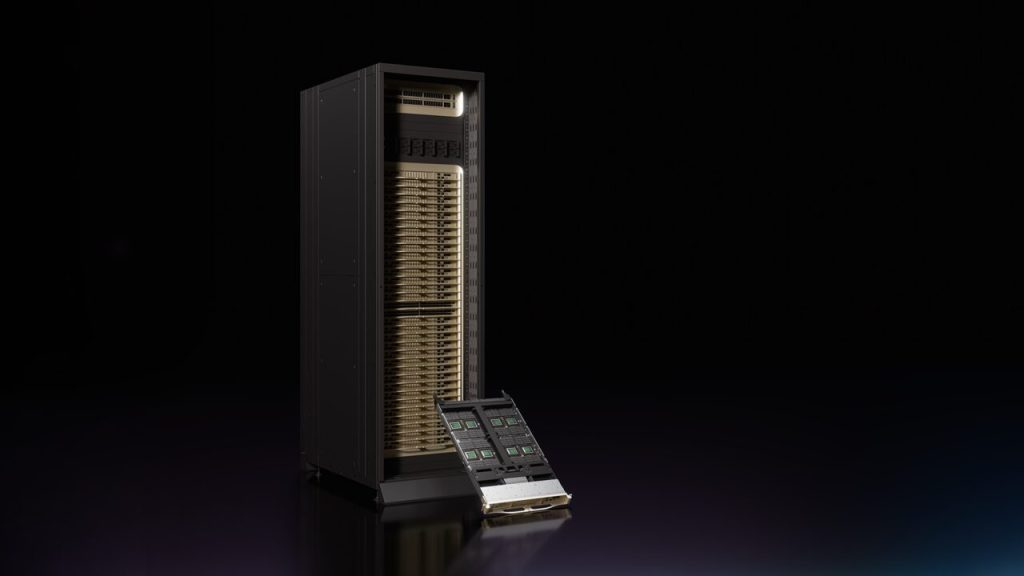
Breaking Boundaries: The Tech Blueprint Behind Nvidia Launches Vera
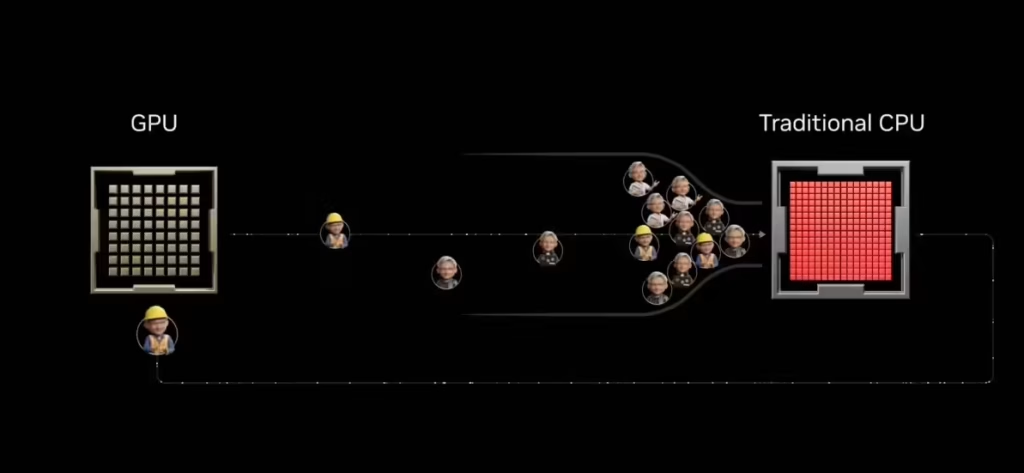
The formal commercialization of an independent microprocessor category signals a dramatic escalation in data center architecture. For decades, traditional hardware layers merely ran serialized application strings. The new era requires custom computing blocks designed specifically to handle continuous, unprompted agent interactions.
Architecture of the Olympus Core and Massive Bandwidth
During the GTC Taipei event, CEO Jensen Huang announced that the enterprise has officially initiated volume production for its standalone data center micro-architecture. When the announcement dropped confirming that Nvidia Launches Vera globally, the technical metrics reshaped industry baselines. Built on a premium TSMC 3nm process node, the system deploys 88 specialized Olympus CPU cores optimized for branch-intensive Python runtimes and sandboxed code execution environments.
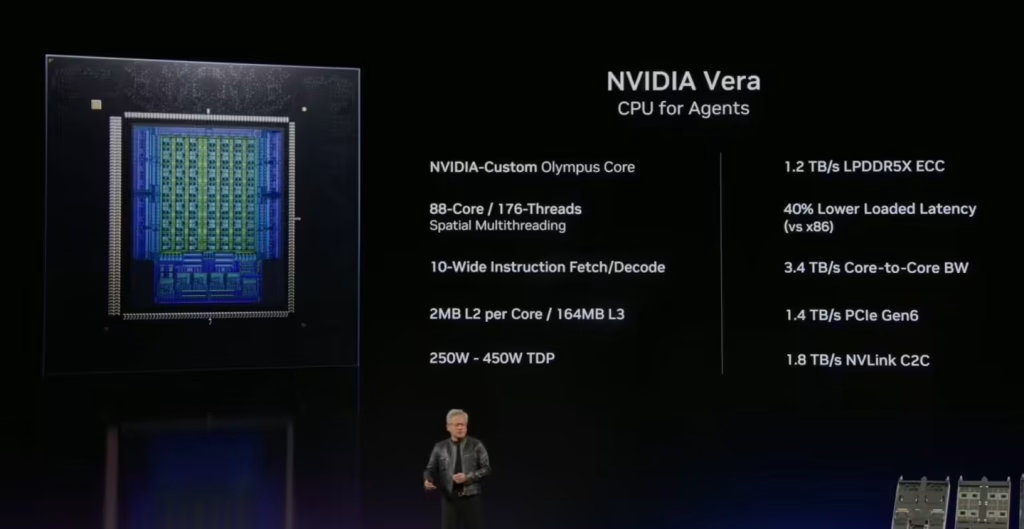
By integrating spatial multithreading arrays alongside a high-density LPDDR5X subsystem, the architecture yields a breathtaking 1.2TB/s of local memory bandwidth. Furthermore, through the deployment of second-generation NVLink-C2C interconnects, the chip maintains 1.8TB/s of bidirectional coherent bandwidth directly to Blackwell acceleration clusters, achieving a massive 1.8x performance multiplier over standard x86 configurations in highly concurrent agent environments.
Hyperscale Adoption and Ecosystem Consolidations
The market response to this compute transformation has been instantaneous across major corporate networks. This long-term hardware procurement directly supports the strategic alignment of global digital operations expanding their native computational scale. Hyperscale infrastructure players and frontier artificial intelligence research labs—including OpenAI, Anthropic, SpaceXAI, and ByteDance—have finalized immediate deployment strategies to integrate these processing blocks into their core layout. Concurrently, major system builders like Dell Technologies, HPE, Lenovo, and Supermicro are launching dedicated computing nodes built on this framework.
To secure market dominance, the company also unveiled the RTX Spark platform for individual Windows workstations, built in partnership with MediaTek. This system relies on a 20-core design sharing memory pools with a 6144-core graphics processor to run localized large language models directly on the client edge.
| Hardware Platform Layer | Core Micro-Architecture Specs | Target Operational Workload | Primary Strategic Partners |
|---|---|---|---|
| Vera CPU | 88 Olympus Cores, LPDDR5X, 1.2TB/s Bandwidth | Agentic Task Orchestration & Sandboxed Execution | OpenAI, Anthropic, ByteDance, OCI |
| RTX Spark SoC | 20 Custom Cores + 6144 Blackwell CUDA Units | Edge Intelligence & Localized Spatial Computing | Microsoft Windows, MediaTek, Dell, Lenovo |
| Isaac GR00T | Jetson Thor Compute Node + MGX Architecture | Embodied Physical AI & Robotic Spatial Parsing | Unitree Robotics (H2 Reference Carrier) |
Beyond desktop computing, the ecosystem expands deeply into physical robotics and autonomous transportation arrays. The company launched its Isaac GR00T developer platform as an open-access system utilizing China’s Unitree H2 humanoid robotics framework as its native hardware carrier, featuring 31 degrees of freedom to democratize automated mechanics research for academic laboratories worldwide. Simultaneously, the company confirmed that leading vehicle manufacturers, including BYD, Geely, Zeekr, and Xiaomi, are actively building automated transit layers using its DRIVE Hyperion computing stack.
The Decoupled Funnel: How an Ecosystem Shift Disrupts Native App Discovery
The hardware transition initiated when Nvidia Launches Vera alters how data routes through the global mobile ecosystem. Historically, user acquisition and discovery followed a highly predictable, screen-centric pipeline. Consumers engaged with web links, entered structured fields, and manually initiated platform redirects to download local binaries onto consumer mobile devices.
This linear funnel breaks down entirely under the weight of an ecosystem shift driven by autonomous microprocessors. While established corporations collide with these financial realities, decentralized startup environments are aggressively redefining corporate valuation metrics. When specialized computing nodes process user commands silently at the system layer, human operators stop interacting with visual application interfaces. Instead, localized software agents interpret raw intent, orchestrate multi-agent workflow chains, and invoke third-party endpoints autonomously behind the scenes.
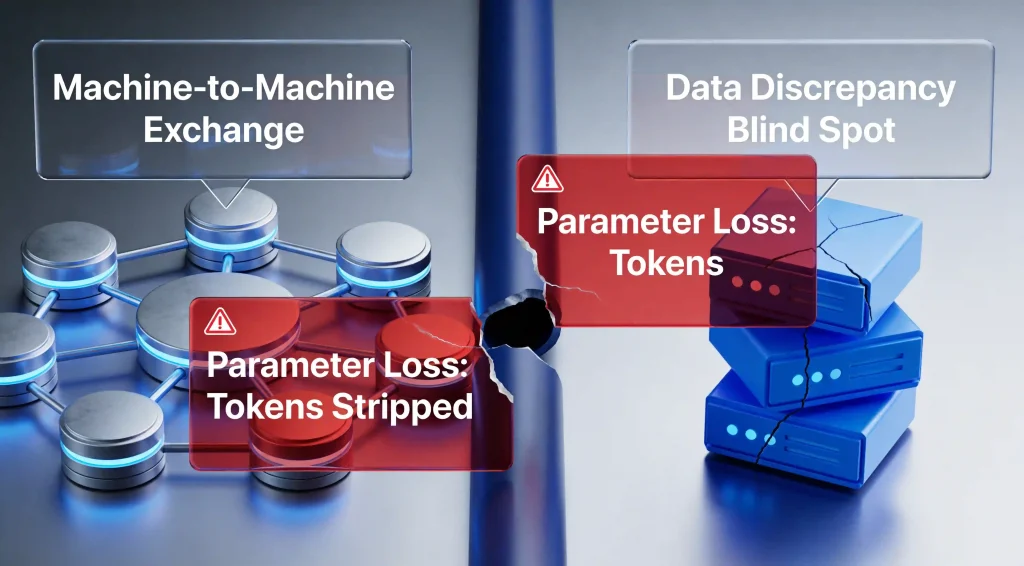
For growth teams, this structural decoupling triggers a severe attribution crisis characterized by absolute parameter loss. When a machine-to-machine exchange completes a programmatic signup or financial transaction within an isolated hardware sandbox, traditional tracking scripts cannot log consumer engagement. Web browser cookies, device identity variables, and front-end transitional markers disappear entirely during these decoupled handoffs. This massive data discrepancy leaves product managers completely blind to their true campaign ROI, destroying legacy tracking systems and isolating apps from their organic audience origins.
Engineering Practice: Deep Link Engineering and Contextual Restoration on Vera Architecture
To retain visibility in an automated landscape where system-level processors decouple human interaction from graphical app screens, technical leads must restructure their core routing frameworks.
Fortifying Ingestion with Deep Link Integration
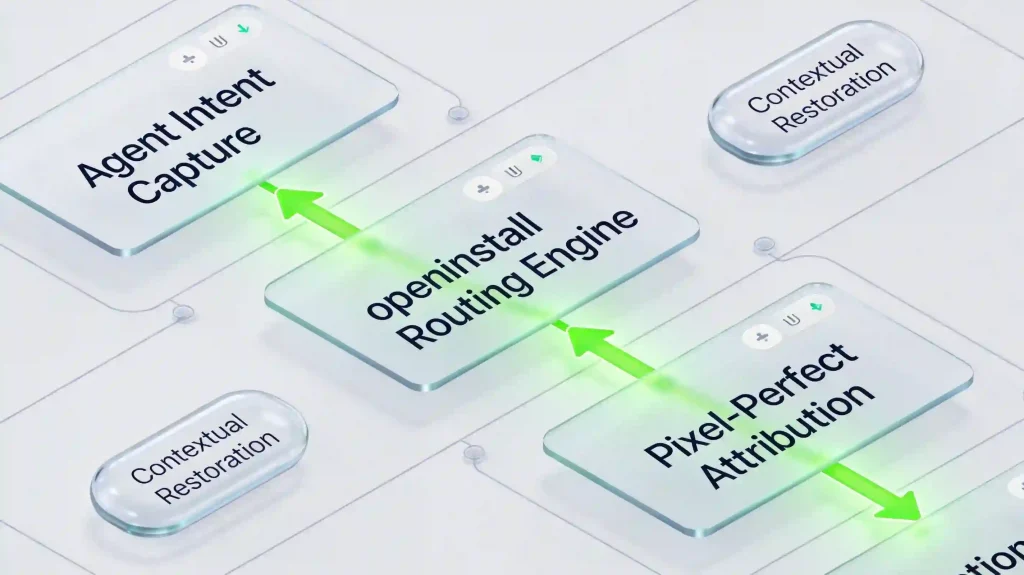
Application engineers must move away from static, browser-dependent redirection links. Instead, development teams must deploy a resilient Deep Link and Universal Links routing engine capable of preserving transaction parameters across fragmented execution layers. By wrapping contextual data directly inside cross-platform app links, growth teams ensure that when a background agent triggers a native system action, the app extracts the source campaign token seamlessly. This eliminates the tracking gaps introduced by decentralized device routing, allowing exact tracking of user engagement metrics.
Preserving Continuity via Contextual Restoration
To prevent high user churn during automated app handoffs, technical setups must ensure absolute contextual restoration. When an edge agent initiates a deferred download command, the underlying system must securely pass the complete interaction history through the app store wall. Upon the first local boot sequence, the application reads the persistent parameter payload, automatically matching the exact state initiated by the agent. This unifies the cross-device user journey without relying on manual promotional codes.
Industry Forward-looking Note: Regarding cross-device parameter tracking for background agent execution layers running on next-generation ARM microprocessors, openinstall’s tech lab is actively coordinating exploratory research with leading global hardware manufacturers to secure seamless, cookieless session continuity.
Impact on Dev & Growth Teams: Adapting to Agentic Hardware Realities
Technical Architecture Resiliency
Software engineers must redesign data ingestion schemas to accept dynamic, unstructured parameter sets generated by autonomous scripting tools. Because machine-driven requests arrive in massive concurrent blocks, system backends must employ flexible ID resolution pipelines. Furthermore, cybersecurity teams must mandate cryptographic signature verification routines at every API boundary. This protects tracking architectures from automated bot networks and malicious scripts designed to simulate human activity and corrupt conversion statistics.
Growth Optimization Strategies
Growth marketing executives must quickly move away from surface-level metrics such as raw impressions or simple click-through volume. As conversational computing renders old click funnels obsolete, budget allocations must prioritize downstream customer life-cycle value (LTV). Marketing specialists must balance their campaigns around verified, human-centric actions, utilizing resilient app attribution setups to capture non-linear touchpoints across the mobile ecosystem.
Frequently Asked Questions (FAQ)
How does the architecture of the Olympus core optimize agentic workloads?
The Olympus core features a 10-width decode engine and a highly advanced neural branch predictor designed explicitly to handle branch-dense Python runtimes and sandboxed code execution loops. This minimizes processing delays, allowing background agents to query databases and execute tools with minimal latency.
Why does the release of specialized data center CPUs create severe data discrepancies for traditional tracking tools?
Traditional analytics tools rely on visible human actions, such as screen clicks and browser redirects, to log tracking tokens. When background agents execute actions via machine-to-machine API links on custom silicon, these visible elements disappear, stripping away tracking tokens and causing severe parameter loss.
How do universal links defend application visibility within a decentralized hardware ecosystem?
Universal links establish a direct, secure mapping between web domains and native application endpoints. When an OS-level intelligent agent triggers a data request, this direct integration allows the native application to launch instantly while preserving tracking parameters without relying on browser cache files.
Industry Observations: Strategic Imperatives Since Nvidia Launches Vera
The strategic transition observed when Nvidia Launches Vera confirms that raw computing capability is migrating rapidly into self-contained, autonomous execution clusters. Continuing to construct growth strategies around traditional, browser-bound digital marketing funnels is a recipe for absolute technical obsolescence.
Moving forward, long-term commercial survival belongs exclusively to development teams that aggressively adapt their routing and data pipelines to align with headless computing protocols. Organizations must invest heavily in robust, cross-platform deep linking frameworks and secure telemetry systems to protect their attribution channels. By ensuring data continuity across both digital and physical interfaces, forward-thinking enterprises can capture real consumer intent, securing sustainable growth as the global technology stack transitions to hardware-driven machine autonomy.