
MiniMax Launches M3? This architectural leap has been conclusively validated by operational testing paradigms across enterprise analytics clusters as frontier computational frameworks expand their context windows to ingest massive streams of digital intent. With the formal commercialization of this million-token architecture, the legacy paradigms of localized user journeys face an immediate distribution shift. For modern software development and growth engineering teams, navigating this expansive context layer requires an immediate infrastructure pivot before conversational interfaces decouple traditional app discovery entirely. As automated execution environments systematically replace standard manual browsing habits, tracking precision hinges on the ability to capture user intent at the deepest architectural layers.
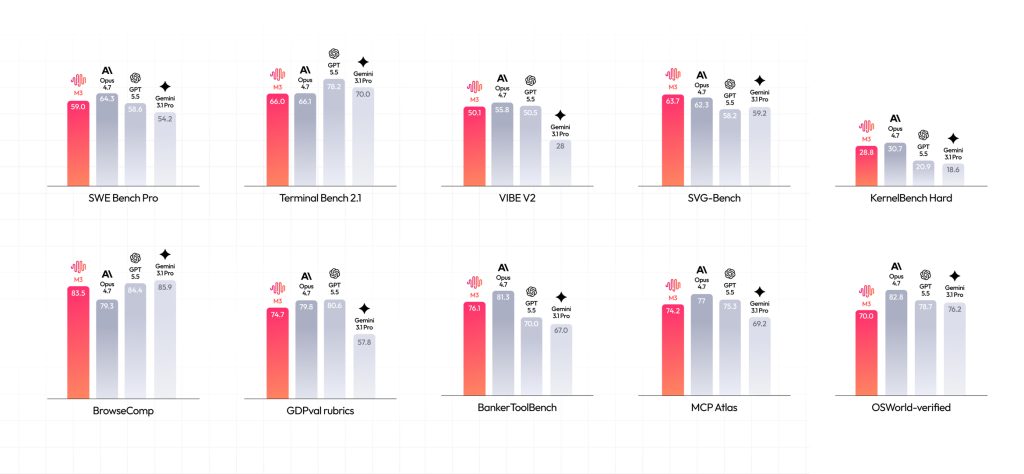
Architectural Breakthrough: Scaling Context with MiniMax Sparse Attention
The core milestone of the MiniMax M3 model lies in its specialized attention mechanism, built to overcome the computational penalties of massive context processing. Traditional full-attention models suffer from an inherent structural flaw: quadratic computational complexity growth relative to sequence length.
To break this limitation, the engineering team designed MiniMax Sparse Attention (MSA), a highly scalable sparse attention architecture that treats context length as a naturally expandable dimension. MSA integrates a precise pre-filtering stage that partitions Key-Value (KV) matrices into exact blocks, achieving superior context coverage compared to legacy methods like Dynamic Sparse Attention (DSA).
At the operator layer, the framework implements a unique “KV outer gather Q” execution loop. By using unified KV blocks as the outer loop to aggregate intersecting queries, the system reads each block exactly once through contiguous memory pathways. This optimization reduces the per-token compute requirement to a mere 1/20th of previous configurations, delivering a 9x speedup during the initial prefilling stage and an automated 15x acceleration during live decoding cycles.
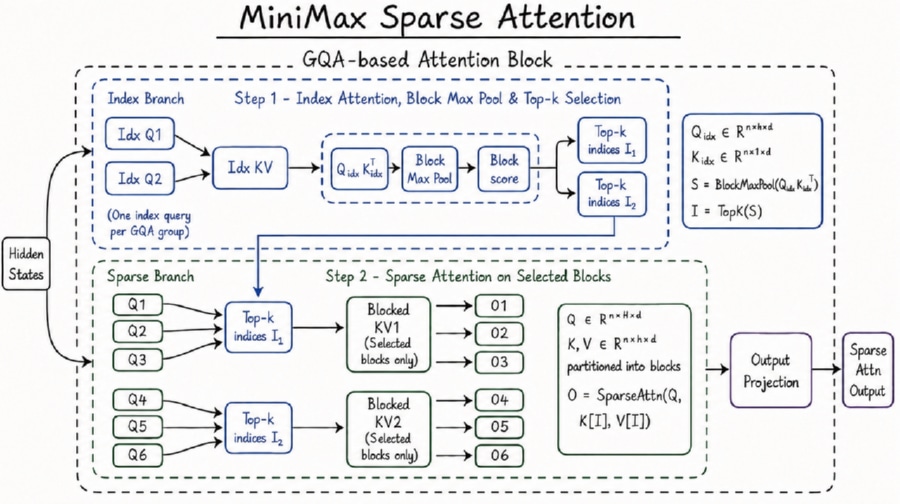
| Benchmark Index | MiniMax M3 Metric | Ecosystem Evaluation Context |
|---|---|---|
| SWE-Bench Pro | 59.0% | Outperforms GPT-5.5 and Gemini 3.1 Pro in autonomous software engineering loops |
| Terminal-Bench 2.1 | 66.0% | Measures end-to-end sandbox execution accuracy under high-concurrency loads |
| MCP Atlas | 74.2% | Evaluates multi-agent protocol routing efficiency across third-party environments |
| Hopper GEMM Peak | 71.3% | Achieved a 9.4x hardware utilization optimization via first-principles iteration |
Breaking the Screen Boundary: Autonomous Agents and Non-Visual Transactions
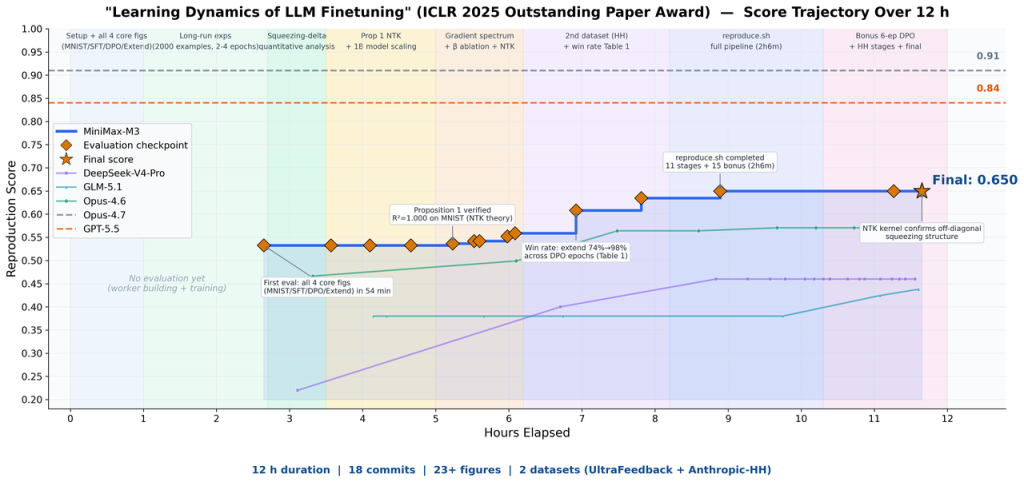
The practical deployment of M3 shifts artificial intelligence past the era of reactive text interfaces into long-horizon project management. In internal engineering trials, M3 executed continuously for 12 hours to independently reproduce an award-winning ICLR research paper, autonomously managing 18 commits and rendering 23 distinct experimental figures without human intervention.
More impressively, when tasked with optimizing an intensive FP8 matrix multiplication kernel on Nvidia Hopper GPUs from a broken code framework, the model executed 1,959 tool calls and completed 147 benchmark submissions over a 24-hour cycle. It bypassed standard performance plateaus to scale hardware peak utilization from 7.6% to 71.3%, proving its capacity for continuous, autonomous problem-solving.
This transition to autonomous execution is heavily accelerated by commercial ecosystem merges. MiniMax’s deep integration with Ant Group’s Alipay infrastructure introduces global Token Pay settlement frameworks directly into multi-agent systems like Mavis. By connecting background agent operations with real-time automated settlement, transactions are decoupled from standard user-facing applications.
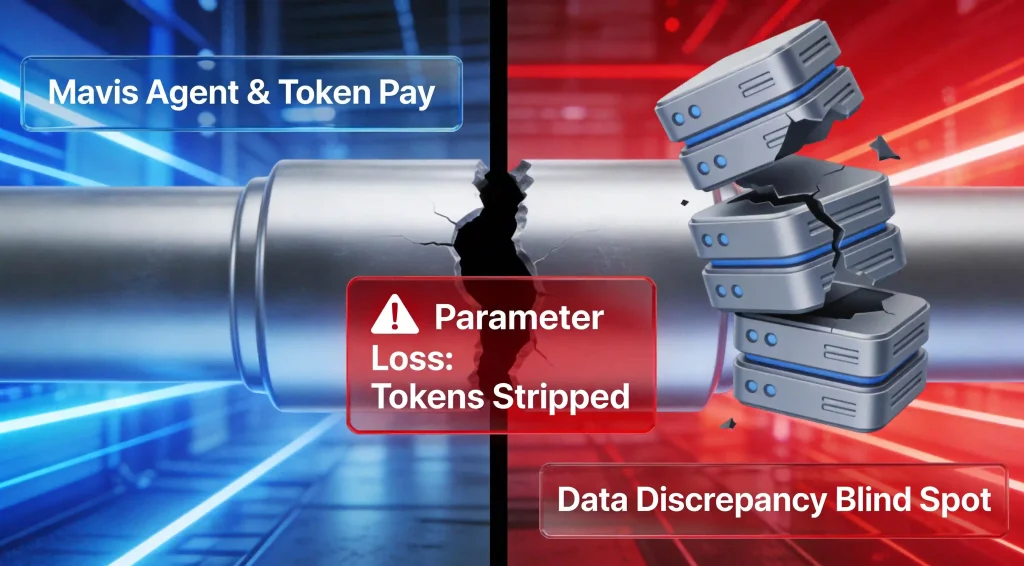
When background agents independently parse documents, execute code, and finalize checkout processes across cross-app environments, standard customer touchpoints evaporate. This creates a highly fragmented mobile landscape where traditional user discovery funnels no longer apply.
Engineering Practice: Deep Link Routing and Contextual Restoration in Massive Windows
The rise of headless multi-agent teams running across diverse computer desktops creates a severe data tracking gap for traditional digital setups. Because an agent operates inside an isolated sandbox or interacts directly with underlying operating systems via terminal execution, standard browser tracking systems fail completely. There are no visual page views, no cookie records, and no standard button clicks. When a background task triggers an application download or completes a transaction, legacy analytics platforms record the activation as an untracked organic event, leaving data metrics severely fractured.
To close this systemic attribution gap, software developers must transition to an advanced Deep Link and Universal Links routing layout. By wrapping unique conversion payloads directly inside platform-agnostic application links, engineering leads can ensure that agent-driven execution paths retain persistent parameters across separate operating systems. This protocol ensures that even when a multi-agent team triggers an enterprise action from inside a closed sandbox, the incoming transaction can be traced precisely back to its original marketing or referral source.
Furthermore, maximizing conversion rates within these massive context windows demands flawless contextual restoration. When an autonomous agent routes an installation payload through an application store, the tracking architecture must preserve the original intent token across the redirection barrier. Upon the first local app launch, the system automatically parses the deferred parameter string, instantly restoring the exact operational state required by the agent. This unified context framework secures session continuity and eliminates user onboarding friction without requiring manual promotional code entries.
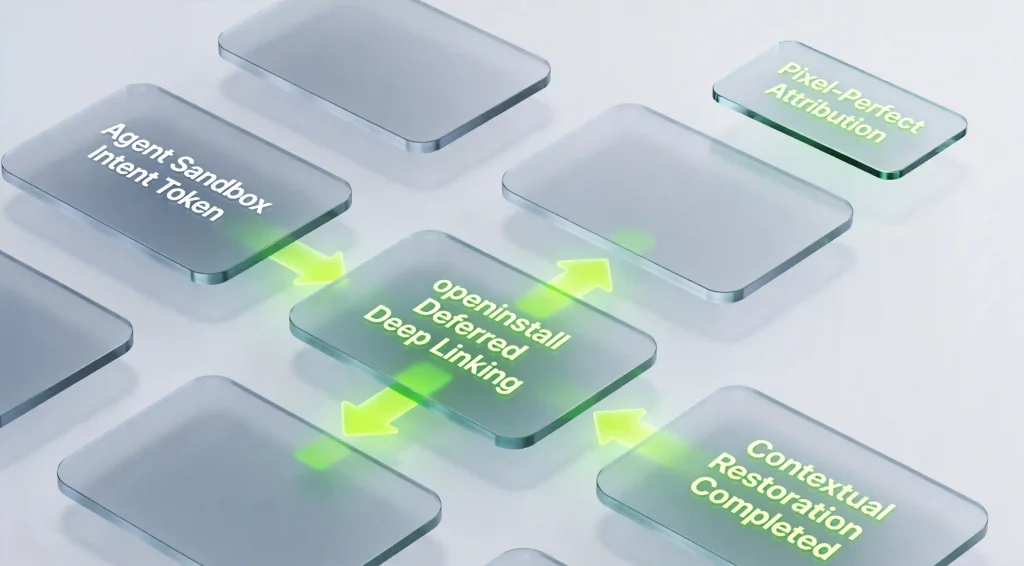
Industry Forward-looking Note: Regarding cross-device parameter transmission for background automated tasks executed inside a million-token sparse context layer, openinstall’s tech lab is currently conducting joint exploratory research with leading global mobile platform providers to establish persistent, zero-cookie identity baselines.
Impact on Dev & Growth Teams: Adapting to Multi-Agent Architectures
Technical Architecture Resiliency
Data engineering teams must scale their ingestion schemas to receive highly dynamic, multi-modal parameter sets from automated API networks. Because machine-driven requests arrive in massive concurrent blocks, system backends must employ flexible ID resolution pipelines. Furthermore, cybersecurity teams must mandate cryptographic signature verification routines at every API boundary. This protects tracking architectures from automated bot networks and malicious scripts designed to simulate agent behaviors and inject fraudulent attribution traffic into business logs.
Growth Optimization and Capital Efficiency Strategies
Growth managers must discard obsolete click-based evaluation metrics. As automated agents take over routine browsing tasks, marketing efficiency must be measured through true downstream retention and customer life-cycle value (LTV). This aligns computational overhead with verifiable conversion yield, ensuring that marketing spend directly impacts core business growth rather than generating inflated vanity metrics within the traffic bubble.
Frequently Asked Questions (FAQ)
How does MiniMax Sparse Attention lower computing costs without reducing model accuracy?
MSA adds an advanced pre-filtering stage that partitions Key-Value (KV) matrices into precise blocks, breaking the quadratic computational complexity of full attention. This allows the model to process a 1 million token context window using only 1/20th of the per-token compute power required by legacy architectures.
Why do long-context agent workflows cause severe parameter loss in traditional analytics tools?
Traditional analytics tools rely on visible human behaviors, such as screen clicks and browser redirects, to capture tracking variables. Because autonomous agents operate via direct machine-to-machine API links inside isolated containers, these visual touchpoints are eliminated, causing traditional tracking markers to drop.
How do universal links secure tracking integrity across decoupled multi-device environments?
Universal links create a direct, secure integration between web domains and native application endpoints at the OS layer. When an automated agent calls an application route, this mechanism allows the native application to initialize instantly while preserving the complete intent payload across system boundaries.
Industry Observations: Dominating the Post-Screen Era
The operational shift highlighted by the launch of MiniMax M3 represents a permanent transformation in the digital distribution landscape. As software engineering and everyday tasks migrate to autonomous, multi-agent frameworks capable of managing long-term sessions, the screen is losing its monopoly over consumer choice. Applications can no longer survive by relying on traditional frontend visibility or aggressive ad placement within closed ecosystems.
Dominance belongs exclusively to enterprise teams that can integrate their digital platforms seamlessly with autonomous background tasks. Relying on legacy web cookies or unvalidated link-tracking models will inevitably lead to absolute metric blindness and broken user loops. Technical leads must secure their infrastructure by deploying parameter-rich, secure deep linking engines. Building these resilient cross-platform bridges is the only way to capture machine-driven intent, ensuring long-term conversion security as the software world transitions to autonomous agent execution.