DeepSeek Seeks 50B Yuan? This historic financing trajectory stands explicitly confirmed by recent technology infrastructure reports as the capital framework of generative computing undergoes a violent structural redistribution. In June 2026, international media outlets revealed that the open-source pioneer is completing its massive initial funding round. This milestone elevates the company’s post-money valuation to a staggering 400 billion yuan. Consequently, as DeepSeek Seeks 50B Yuan and deepens the ongoing software price wars, digital developers face an operational emergency. Specifically, the collapse of token prices accelerates automated bot traffic across distributed ecosystems. Meanwhile, analytics leads find it incredibly difficult to identify authentic human conversions within legacy pipeline configurations.

News and Context Breakdown: The Billions Driving the Market
The details surrounding this initial capital deployment expose a dramatic transformation in how advanced AI operations secure long-term resources. DeepSeek has moved beyond basic developer adoption to become an institutionally backbacked titan.
The Scale of the Cap Table Expansion
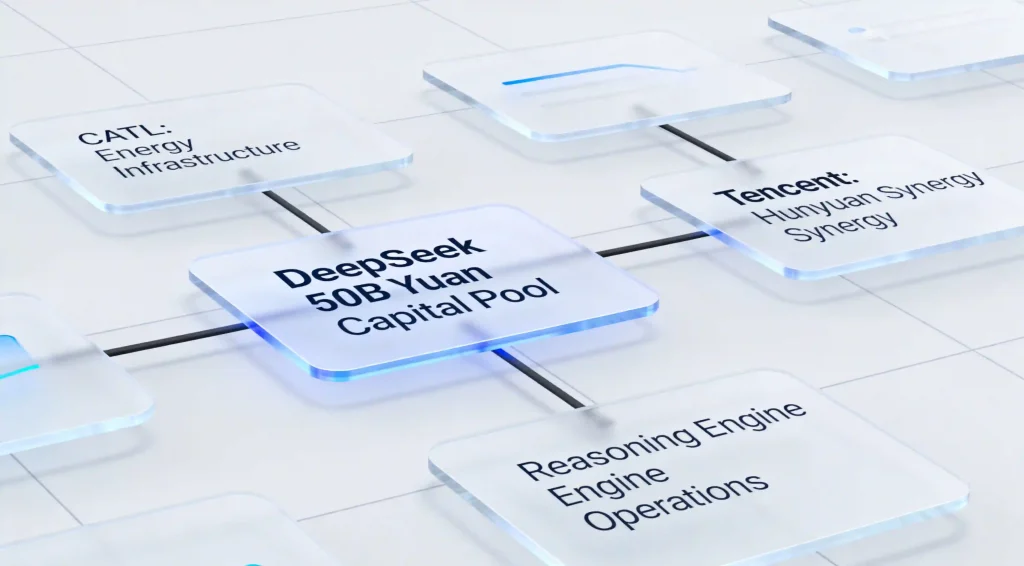
Specifically, the total capital raised in this round reaches approximately 50 billion yuan, which translates to roughly 7.4 billion US dollars. The post-money valuation is currently locked between 350 billion and 400 billion yuan. Crucially, founder Liang Wenfeng has personally committed 20 billion yuan of his own wealth to lead the round. Furthermore, the transaction architecture enforces a hard limit of fewer than ten external participants. The entire deal expects final closure within the coming weeks. At this moment, the company is finalizing documentation with elite backing entities. These groups include the China National Artificial Intelligence Industrial Investment Fund, NetEase, and e-commerce giant JD. Meanwhile, regional institutional heavyweights like IDG Capital, Cornerstone Capital, and Monolith Capital occupy prominent positions on the finalized investor list.
Strategic Infrastructure Alignments
Furthermore, the inclusion of industrial stalwarts highlights a major pivot toward self-sufficient technology ecosystems. For instance, Contemporary Amperex Technology Co. Limited (CATL) plans to inject 5 billion yuan into this round. As the undisputed global leader in the electric vehicle battery supply chain, CATL is rapidly expanding into artificial intelligence data center management according to reports by Reuters. Crucially, the astronomical computing requirements of models like the V3 architecture and the R1 reasoning engine demand unprecedented electrical scale. Consequently, CATL aims to capture long-term commercial opportunities by providing specialized high-capacity energy hardware and industrial energy storage solutions directly to processing hubs.
The Balance of Competitive Alliances
Meanwhile, tech giant Tencent is executing a major defensive maneuver by committing 10 billion yuan to the capital pool. This move positions Tencent as the primary external corporate strategist behind the open-source project. Currently, Tencent manages its proprietary Hunyuan infrastructure. However, its market footprint lags visibly behind competitors like ByteDance’s Doubao application. Specifically, supporting an open-source model allows Tencent to challenge Alibaba’s dominant Qwen structure effectively. This alignment shows that the primary battlefield has shifted from basic algorithmic superiority to macro-scale infrastructure deployment.
The Attribution Crisis: Token Price Collapses and Tracking Vacuums
As DeepSeek Seeks 50B Yuan and subsidizes token delivery worldwide, a silent tracking disaster is disrupting the mobile growth economy. Performance managers face a severe degradation of data fidelity.
Historically, growth architectures relied on clean user pathways across desktop and mobile screens. A user viewed a standard campaign, executed a crisp link tap, and landed inside an app store interface. This direct chain allowed marketing software to document referral data without friction.
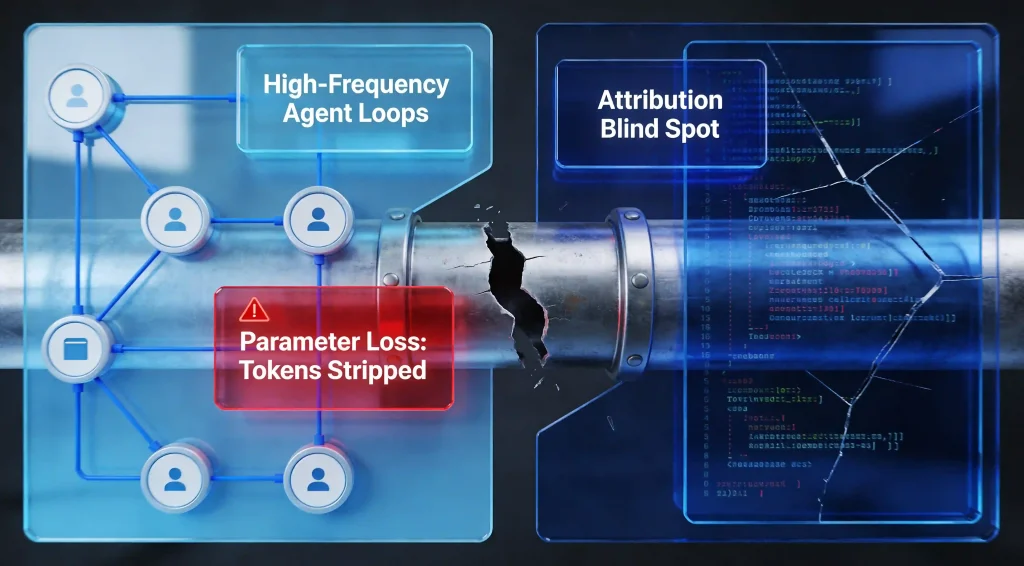
However, this linear process breaks down when cheap computing power enables hyper-automated agent loops. When token costs drop by 90% or more, developers build continuous background applications. These systems crawl deep links, automate service selections, and initiate application installations without triggering frontend visual scripts. Specifically, the visual click vanishes entirely from the conversion funnel. As a result, critical referral headers and device identity tags disappear inside background processes. This data vacuum prevents legacy platforms from confirming the exact marketing channel that inspired the action. Growth teams see high conversion volume but cannot isolate the real traffic source. This blind spot completely invalidates standard return on ad spend (ROAS) equations, forcing teams to burn capital blindly.
Engineering Practice: Building Resilient Attribution Foundations
To mitigate the tracking deficits caused by high-frequency automated ecosystems, development leads must abandon superficial frontend web tags. True structural visibility requires a modern, platform-agnostic routing layer.
Reclaiming Context via Deferred Deep Linking
Technical groups must employ advanced Deferred Deep Linking methodologies to preserve parameter data across isolated operating layers. This pipeline securely links the background intent signature to a unique device snapshot before the operating system triggers a store redirection. When the application launches for the first time on a consumer handset, the code immediately extracts the underlying parameter array from the cloud network. Consequently, the application restores the user context flawlessly, bypassing manual entry barriers completely.
Securing Source Integrity with Explicit Channel Logs
Furthermore, engineering leads should implement a comprehensive Mobile Attribution framework to track incoming data flows at the absolute source. By embedding unalterable tracking tokens directly into the underlying model request strings, teams establish a robust data record. For example, whenever an automated assistant queries an application endpoint, the network appends a distinct channel tracking code to the metadata container. This approach creates a reliable, permanent log, allowing financial systems to isolate organic human discovery from automated background loops.

Industry Forward-looking Note: Regarding cross-device parameter tracking for autonomous intent traffic running across next-generation execution containers, openinstall’s tech lab is currently conducting joint exploratory research with leading enterprise partners to standardize metadata transit protocols.
Impact on Development and Growth Teams
- For Architecture Teams: Software engineers must build dynamic intake systems capable of parsing multi-layered parameter payloads from background automation tools. Furthermore, backend validation layers must enforce cryptographic signature checks on every inbound API call. This protection layer prevents malicious script operations from skewing analytic logs and corrupting storage data.
- For Growth Leads: Marketing managers must rapidly replace simple click metrics with comprehensive lifetime value (LTV) models. As cheap token deployment expands background machine interactions, volume metrics lose their accuracy. Spending must align exclusively with data channels that offer complete white-box visibility and verified tracking streams.
Frequently Asked Questions (FAQ)
Why is founder Liang Wenfeng committing personal capital alongside major tech institutions?
The personal 20 billion yuan commitment ensures absolute long-term founder control over strategic decisions. As DeepSeek Seeks 50B Yuan, this configuration protects the open-source roadmap from the shifting commercial priorities of large corporate competitors.
How do plummeting token costs complicate legacy mobile tracking funnels?
Extreme price decreases prompt developers to construct automated agent layers that perform app tasks in the background. Because these processes do not rely on standard user clicks, they bypass frontend tracking completely, creating significant attribution data gaps.
What advantage does a centralized channel tracking log offer over a traditional cookie framework?
Centralized channel logs embed permanent, unalterable identity variables directly inside data requests rather than relying on browser storage. Consequently, tracking accuracy remains fully operational even when client-side security updates purge standard cookie profiles.
Industry Observations
The massive capital influx redefining the technology sector confirms that artificial intelligence is moving into a phase of intense operational consolidation. Continuing to measure digital reach using superficial browser metrics is a recipe for absolute corporate irrelevance. Long-term commercial expansion belongs exclusively to teams that build verifiable, server-side data infrastructure today. Organizations must secure their analytics pipelines against the rising tide of machine-generated automation. By focusing heavily on unalterable channel attribution and clean parameter restoration, forward-looking enterprises can successfully navigate the current price wars, turning raw compute into predictable, long-term commercial dividends.