

App promotion and viral marketing are becoming increasingly difficult. What can be done when aggressive user acquisition efforts yield little results, and user churn rates remain high? Are there aspects of the promotion process that are highly off-putting to users? This article discusses, from a user experience perspective, the problem of user churn caused by the invitation code entry step in viral marketing for mobile apps.
What to do when app promotion and viral marketing are becoming increasingly difficult?
Despite our best efforts to acquire new customers, the results are still not significant. What exactly went wrong?
The user churn rate is high; are there any processes in the marketing campaign that are extremely off-putting to users?
In today’s highly homogenized app market, product details and user experience have become crucial factors for an app’s success in industry competition. Today, we will discuss from a user experience perspective the problem of user churn caused by the invitation code entry process in app viral marketing, and its solutions.
- Problem: User churn during rapid growth/expansion
The market is never short of growth channels, but user referral programs are particularly important. Almost every app now develops a referral feature, aiming to constantly incentivize existing users to convert potential users around them.
Making every individual user a product’s communication channel and creating dense dissemination among potential users is the dream of every product manager. However, in practice, invitation-based registration campaigns often fail to achieve the desired viral effect. Besides reviewing the campaign’s planning, the user drop-off caused by the cumbersome invitation code process should not be overlooked. Simplifying the invitation steps and optimizing the user experience will make viral marketing significantly more effective.
In traditional viral marketing, app products often use invitation codes to verify the source of information, identify which existing user invited a new user, and reward the relevant existing user (the inviter).
Filling in an invitation code: The principle is very simple; the inviter generates a unique invitation code for the new user to fill in. To make it easier for new users to fill in the code, some developers have even invented methods such as allowing users to choose their own invitation codes.
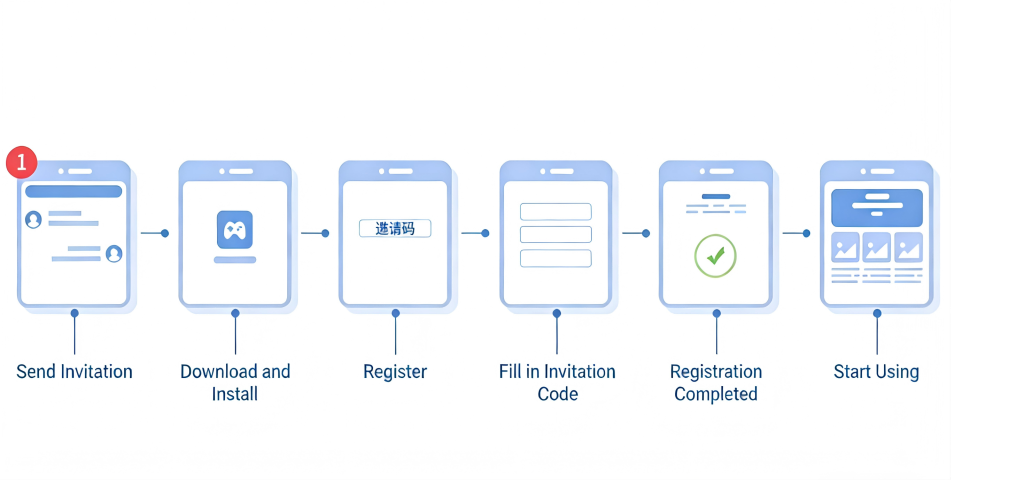
The inclusion of the invitation code entry step is essentially only to satisfy the statistical needs of developers and marketers. It doesn’t provide a smooth user experience; instead, it adds an extra step to the user’s installation process, creating another layer in the conversion funnel and increasing the potential for user drop-off. If existing users find the rewards insignificant, and new users are put off by the cumbersome “enter invitation code” step, choosing to “abandon registration” or “skip the invitation code,” the invitation registration campaign will ultimately fail.
Is it really worth sacrificing the conversion rate from exposure to installation in order to obtain data?
- Solution: Install without entering an invitation code.
In fact, there are already technologies available domestically that can perfectly solve this problem. Before discussing the technology, we need to clarify a logical point: why does the user experience come to a halt at the invitation code entry stage? The main reason is that the traditional method of entering invitation codes is done manually, and users easily lose patience at this step. If we can transform “manual invitation code entry” into “automatic completion by the program and skipping the invitation step,” the problem will naturally be solved. This involves the application of channel source tracking technology.
Below is a brief explanation of the principles behind this channel source tracking technology:
- Developers integrate a third-party web SDK into the shared HTML5 page, and when publishing the sharing link, they dynamically append arbitrary custom parameters to the URL (such as promotion channel ID, invitation code, game room number, etc.).
- When a terminal accesses this HTML5 page, the third-party web SDK will simultaneously determine the device’s personalized information and collect custom parameters, uploading them to a third-party server. The Android/iOS SDK then retrieves the temporarily stored custom parameters from the third-party server.
- Developers can customize various dynamic parameters in the sharing links according to their needs. For example, by including the user ID of the app inviter in the sharing link URL, they can achieve the effect of eliminating the need to enter an invitation code.
Based on this principle, app developers can accurately identify the source of each installation without the need for channel-specific packaging or requiring users to enter channel identification codes (i.e., invitation codes or promotional codes).
- Value: Accelerating App user growth
We know that each additional step in the promotion process leads to a certain amount of user attrition. By applying this method effectively, app promotion will become significantly more efficient. From the user’s perspective, they no longer need to enter complex and difficult-to-remember invitation codes, resulting in a faster and smoother user experience, and significantly improved conversion and retention rates. For app developers, the ability to automatically and accurately track installation sources will also save a considerable amount of effort.
The essence of eliminating the need for invitation codes lies in tracking the source of referrals. Since this technology allows for tracking the source of invitations, it can naturally be applied to countless fields wherever there is a need for monitoring or identifying referral sources, such as: tracking the effectiveness of offline promotions and advertising campaigns. This method has already been proven effective in some markets, and many more potential applications are waiting to be discovered.
For referral marketing campaigns that offer rewards for registration, it’s crucial to prioritize user experience. Even if you can’t create a surprising experience for users, you shouldn’t create any obstacles in their user journey. Setting too many hurdles will only deter potential users and lead to early attrition. By effectively utilizing this method, you can maximize the effectiveness of your campaign.