

Unitree Clears IPO? This high-speed regulatory approval confirms that physical AI is ready for prime time. On June 1, 2026, the Shanghai Stock Exchange (SSE) listing committee officially approved the company’s listing application. Remarkably, the review cycle concluded in just 73 days. This milestone signals deep institutional confidence in Embodied Intelligence. As the firm prepares to become the first publicly traded physical AI entity in the A-share market, developers must ask: How will the shift from screen-bound apps to multi-modal hardware redefine the future of traffic attribution?
News and Environment Breakdown: The Rise of Physical AI
The robotics industry is currently experiencing a rapid maturation phase. Unitree Robotics has transitioned from a specialized research startup to a global leader in hardware volume. This IPO serves as a direct mirror of the structural changes occurring within the broader national economy.
The Fast-Track Regulatory Approval
The speed of this listing is unprecedented. Unitree filed its application on March 20, 2026. By June 1, the review committee granted approval. This 73-day cycle sets a new benchmark for the STAR Market’s pre-review mechanism. It demonstrates a strong regulatory preference for “hard tech” enterprises that align with the national strategic focus on New Quality Productive Forces.
Global Scale and Financial Performance
Unitree is not just a research project; it is a manufacturing powerhouse. In 2025 alone, the company shipped over 5,500 humanoid units. This achievement makes it the global leader in pure humanoid robotics volume. Financial data underscores this growth. Revenue soared from 159 million RMB in 2023 to 1.699 billion RMB in 2025. Furthermore, the company reported a net profit of 278 million RMB in 2025. The firm plans to raise 4.2 billion RMB through this IPO to accelerate the development of robotic models.
The Embodied AI Technology Stack
The firm’s technical edge lies in its vertical integration. Unlike competitors that rely on external models, Unitree focuses on hardware and “small brain” integration. The company has made significant strides in self-developed World Model Architecture (WMA). These models allow its humanoid robots to perform complex tasks without constant remote supervision. Consequently, the recent integration of natural language instruction sets enables robots to process real-time semantic data, plan trajectories, and execute precise physical movements.

The Attribution Crisis: Traffic Flow and Data Gaps
As Unitree Clears IPO and physical AI hardware populates industrial spaces, the digital landscape faces an attribution challenge. The shift from mobile-first to embodied-first computing requires a rethink of how we track “task traffic.”
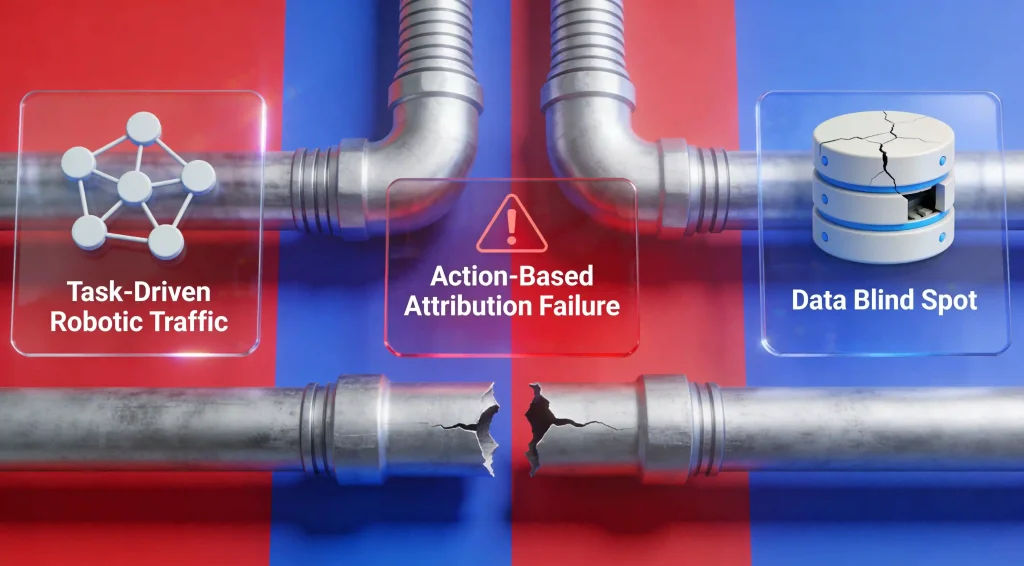
Traditional attribution funnels rely on visual user engagement—clicks, swipes, and app opens. However, physical AI hardware does not rely on these interfaces. Instead, interactions are driven by voice, gesture, and autonomous task completion. When a robot completes a request, it generates an “action-based conversion” rather than a “page-view conversion.”
This creates a significant data blind spot for App developers. If a user triggers an order through a robot’s interface, how does the App know which marketing channel drove that decision? Existing attribution metrics fail to capture this machine-to-machine intent. Growth teams currently see a disconnect between hardware adoption and conversion logs. Without a unified way to bridge these systems, physical robot data remains an inaccessible black box.
Engineering Practice: Building Resilient Attribution Foundations
To navigate the fragmentation caused by this hardware-software convergence, engineering teams must adopt transparent methods for data reconciliation.
ChannelCode for Unified Tracking
Developers need to treat hardware-based agents as a new category of traffic sources. By implementing ChannelCode, teams ensure every hardware unit carries a specific, non-destructive identifier. This identifier travels with the task data, allowing for transparent reporting. Consequently, teams can categorize traffic originators even when standard browser cookies fail. This creates a source-of-truth log, allowing teams to calculate true marketing performance.
Contextual Restoration for Embodied Flows
When hardware interacts with software, maintaining the state of the user’s intent is critical. Implementing Deferred Deep Linking is essential here. Even when a robot initiates an App request, the system must retain the specific context parameters through the installation process. This ensures that when the target App launches, it provides the user with an immediate, personalized experience.

Industry Forward-looking Note: Regarding cross-device parameter passing for autonomous intent traffic, openinstall’s tech lab is currently conducting joint exploratory research with leading enterprise App partners to define standard metadata formats for AI-generated traffic flows.
Impact on Development and Growth Teams
- For Architecture Teams: Engineering leads must treat hardware integration as a first-class citizen. APIs should be structured to accept incoming parameters from robotic interfaces. Building modular, API-first software allows for easier adoption of future physical AI workflows.
- For Growth Leads: As Unitree Clears IPO and the robotics market heats up, traditional metrics will be insufficient. Growth teams must demand better observability into the “intent-driven traffic” generated by AI hardware. Prioritizing metrics that track the completion of tasks—rather than just app activations—will become the key competitive advantage.
Frequently Asked Questions (FAQ)
Why is the Unitree IPO considered a milestone for physical AI?
The IPO confirms the economic viability of humanoid robotics. Unitree’s rapid approval and its ability to scale production—with over 5,500 units shipped—validate the shift from theoretical research to industrial-grade deployment in the physical AI domain.
How does physical AI differ from traditional cloud-based AI?
Physical AI requires the integration of motor control, spatial awareness, and real-time decision-making. While cloud AI focuses on synthesis, physical AI must account for mechanical constraints and the safety requirements of operating in human spaces.
What is the advantage of using deferred deep linking in this environment?
It ensures that the context from the physical interaction is passed directly into the software. This minimizes user friction, as the App opens immediately to the relevant feature or state required by the robot’s task execution.
Industry Observations
The listing of Unitree Robotics signals that the era of Physical AI has arrived. As the industry moves toward mass production, reliance on high-fidelity data attribution becomes the backbone of scalable success. For App developers, the challenge is to build software that understands its context within an automated ecosystem. By prioritizing unified attribution pipelines, teams ensure their products remain default choices for autonomous hardware. As Unitree Clears IPO, it leaves no doubt that future infrastructure depends on the precise reconciliation of digital intent and physical action.