
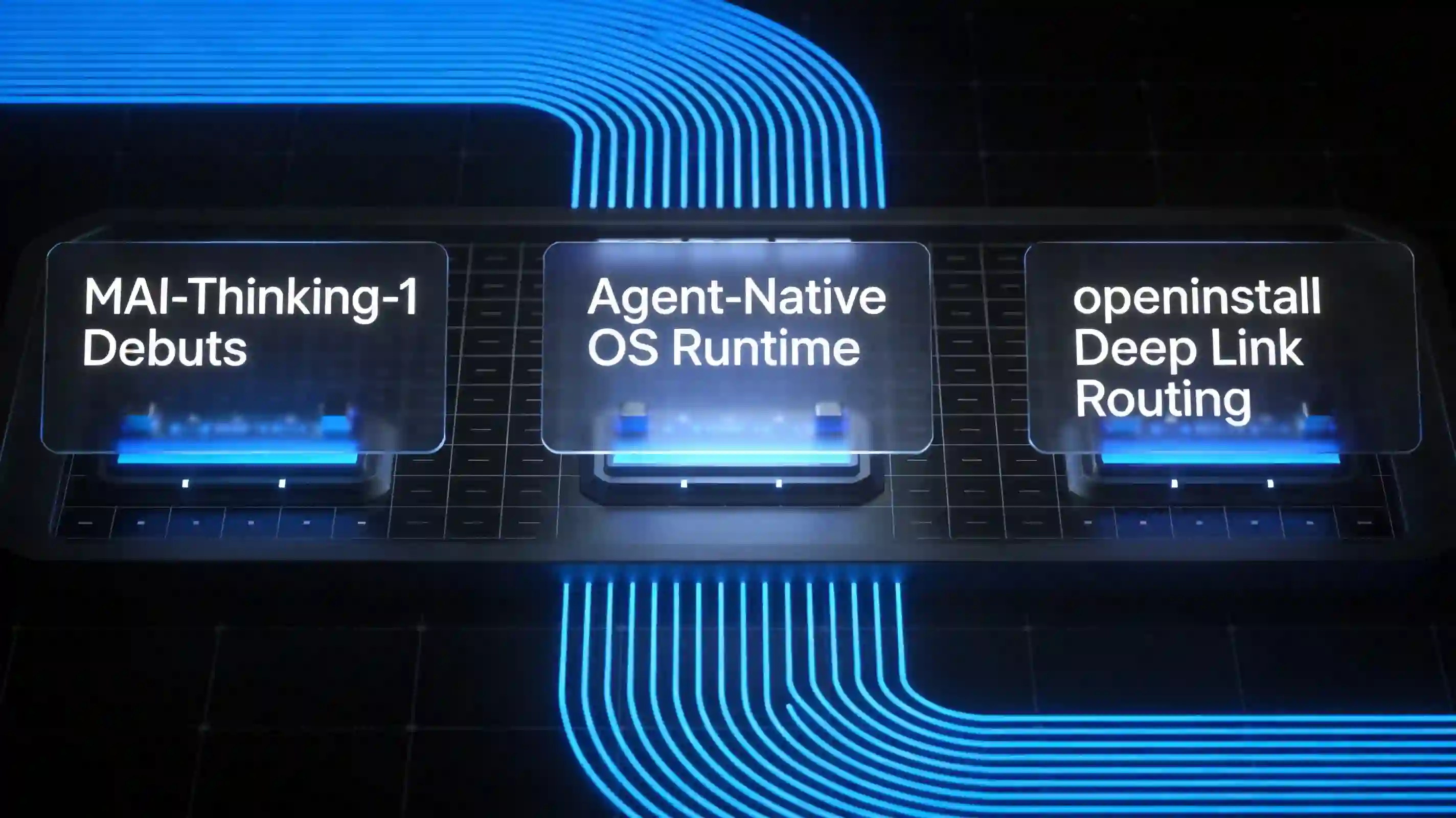
MAI-Thinking-1 Debuts? This paradigm shift signals a radical change in software design. Microsoft formally positions Windows as an agent-native runtime at Build 2026. Specifically, advanced reasoning capabilities are moving directly into the operating system. This development ends the era of basic text widgets. Crucially, the MAI model family relocates massive digital traffic volumes. Most consumer traffic moves from visual web pages to background engines. For engineering teams, this evolution triggers an immediate attribution emergency. Standard click-based tracking frameworks face absolute obsolescence as a result. Consequently, developers must quickly rebuild their routing architectures. They must capture intent-driven data before traditional footprints disappear completely.

News and Context Breakdown: The Leap into the Agentic Era
The announcements at the Build 2026 developer conference outline a massive restructuring of software infrastructure. Microsoft is aggressively moving away from simple copilot chat interfaces. Instead, the tech giant embeds autonomous action layers into every tier of its technology stack.
The Architecture of the MAI Model Family
Specifically, Microsoft launched seven in-house AI models to compete with frontier research labs. The centerpiece of this rollout is MAI-Thinking-1. This mid-sized reasoning model features 35 billion active parameters and roughly 1 trillion total parameters. Furthermore, engineers built the model from scratch on clean, commercially licensed data. This strategy entirely avoids the flaws of third-party dataset distillation.
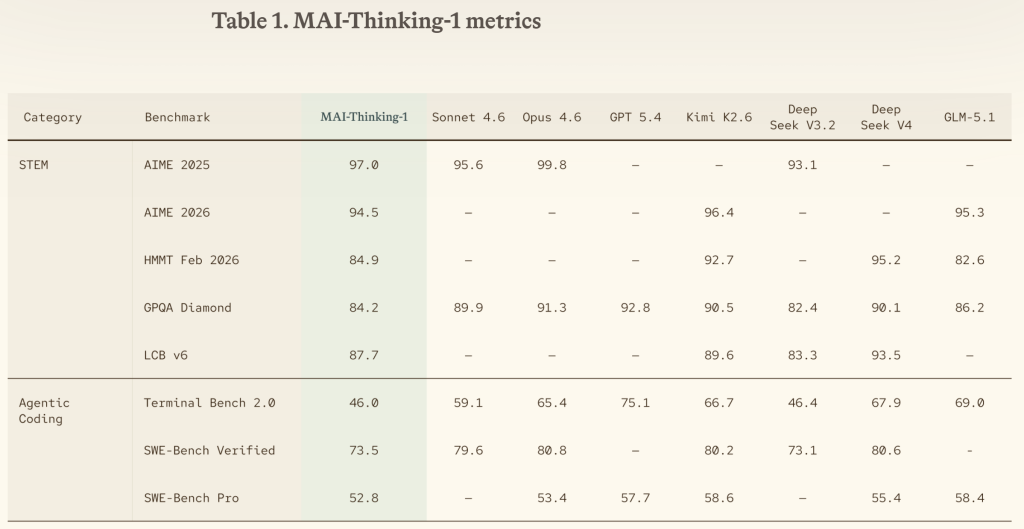
Meanwhile, its Sparse Mixture of Experts (MoE) design optimizes local resource consumption. This architecture yields a significantly smaller inference footprint compared to legacy systems. Crucially, the model excels at complex, multi-step instructions and long-context processing. In advanced mathematical testing, MAI-Thinking-1 scored 97.0% on the AIME 2025 benchmark. Furthermore, its AIME 2026 score reached 94.5%. This score demonstrates elite scientific reasoning capabilities within its weight class.
Concurrently, Microsoft rolled out MAI-Code-1-Flash for real-time source code generation. The company immediately integrated this asset into GitHub Copilot and Visual Studio Code. This integration accelerates everyday developer workflows. Additionally, the family includes MAI-Image-2.5 for creative editing. This asset works alongside MAI-Transcribe-1.5, which processes transcription tasks across 43 languages. It runs at five times the speed of competing frameworks.
Redefining the Workspace with Proactive Agents
Furthermore, Microsoft introduced Microsoft Scout to automate routine enterprise actions. Scout acts as an autopilot system for the workplace. Specifically, it scans Microsoft 365 environments without waiting for explicit human commands. It coordinates calendars and prepares meeting dossiers independently. It initiates tasks proactively across Outlook and Teams based on ambient workflow signals.
Meanwhile, the company unveiled Project Solara, an agent-focused operating runtime built on top of Android. Project Solara powers a new category of ambient hardware devices. These devices include smart badges and dedicated desktop terminal hubs. To support these headless operations, Windows introduced Microsoft Execution Containers. This new sandboxing infrastructure isolates background agent execution paths at the kernel level.
Majorana 2 and the Quantum Roadmap
On the hardware side, Microsoft unveiled its second-generation quantum processor, Majorana 2. The company accompanied this release with a bold commercial roadmap. Specifically, Microsoft plans to deliver a fully fault-tolerant quantum computer before 2029.

Traditional quantum systems struggle with extreme fragility. Their qubits usually collapse within microseconds. However, Majorana 2 relies on topological quantum bits to achieve a stable 20-second coherence lifetime. Under pristine laboratory conditions, this lifespan extends to a full minute.
Furthermore, the chip utilizes unique physical hardware properties to encode quantum information non-locally. This hardware design protects the system from environmental noise. As a result, Majorana 2 achieves a 1000-fold reliability multiplier over previous experimental configurations.
Strategic Financial Layout and Market Realities
This massive technology deployment arrives amid intensifying competition for enterprise AI dominance. Microsoft continues to protect its massive investments. These investments include 13 billion dollars in OpenAI and 5 billion dollars in Anthropic. However, the creation of the proprietary MAI family indicates a clear desire for infrastructure independence.
Following the announcements, Microsoft stock experienced a 4.17% market correction. The stock closed at 441.31 dollars per share with a total market capitalization of 3.28 trillion dollars. This movement followed a three-month high triggered by an earlier partnership with NVIDIA. Enterprise buyers are now looking closely at the real ROI of these massive capital expenditures.
The Attribution Crisis: Traffic Flow and Data Gaps
As autonomous workflows take hold across Windows and Project Solara, traditional application discovery mechanisms break down. Growth managers face an unprecedented tracking deficit. This challenge shifts attention away from standard user acquisition metrics.
Historically, growth funnels operated on a clear, screen-centric model. Users viewed an advertisement first. Then, they clicked a tracked URL. Finally, they underwent a clean redirection to an application store. This linear sequence provided reliable attribution records.
However, this tracking loop snaps completely when proactive assistants like Microsoft Scout handle execution. When an agent acts on ambient data, the traditional visual click disappears. The agent initiates actions directly inside isolated sandboxing environments like Microsoft Execution Containers.
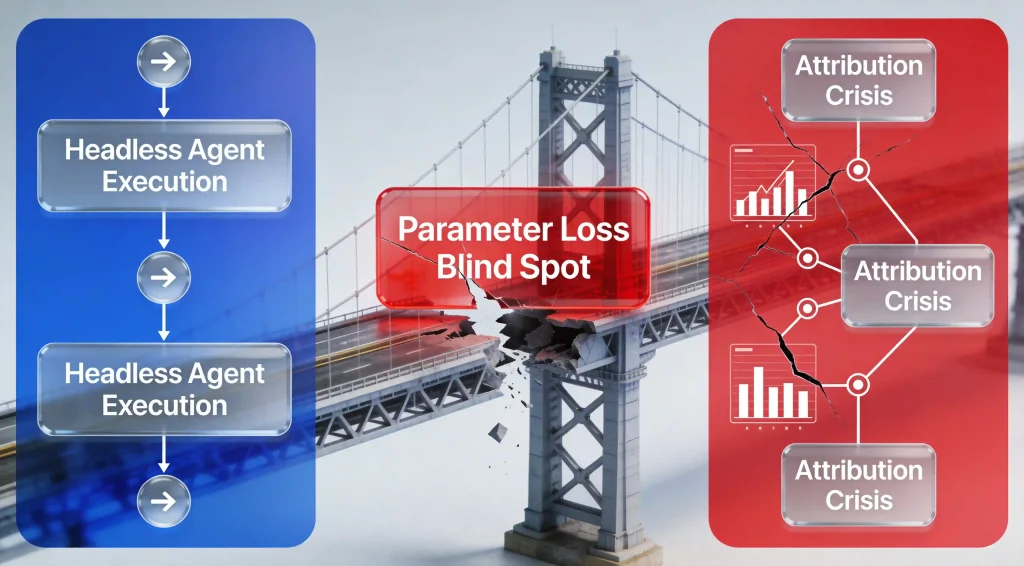
Consequently, the entire contextual footprint vanishes. Traditional tracking scripts cannot log these machine-to-machine exchanges. Browser cookies, device identity variables, and campaign referral tokens disappear completely during these background operations.
This data gap introduces a severe attribution crisis. Growth leads can see application interactions occurring on their servers. Yet, they cannot trace those actions back to the original marketing source. This blind spot destroys standard return on ad spend (ROAS) calculations. Performance teams become unable to optimize their acquisition budgets.
Engineering Practice: Building Resilient Attribution Foundations
To close the visibility gap introduced by autonomous reasoning runtimes, technical leads must move away from surface-level frontend tracking. Modern software architectures require deep, network-level routing solutions.
Reclaiming Context via Deferred Deep Linking
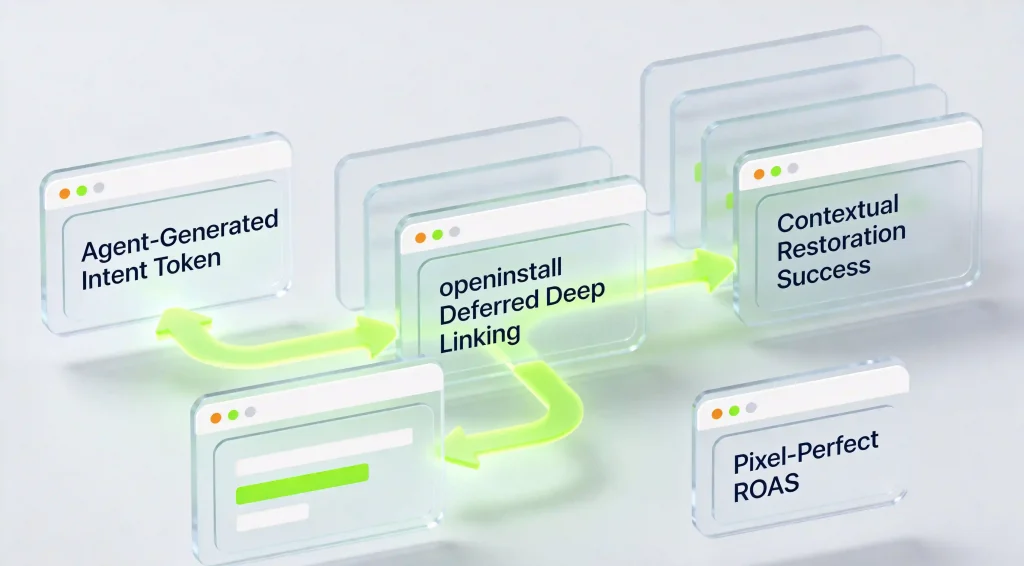
When a background agent triggers an application installation request, the tracking parameters must survive the platform transition. Integrating a robust Deferred Deep Linking infrastructure resolves this exact vulnerability.
This system securely binds the agent-generated intent token to the target device profile before the app store redirect occurs. Upon the first local boot sequence, the application extracts the persistent parameter payload from the data plane. Consequently, the application restores the exact state initiated by the agent. This approach preserves user context without requiring manual verification codes.
Securing Inbound Paths with ChannelCode
Furthermore, development teams must deploy decentralized link management models to categorize multi-modal traffic sources. Implementing ChannelCode attribution enables engineers to inject immutable domain tracking tokens directly into the underlying execution strings.
When an intelligent assistant queries a database or interacts with an external endpoint, the system automatically appends the unique channel code to the request metadata. This approach eliminates the reliance on volatile browser cookies or easily blocked tracking scripts. As a result, the backend analytical architecture retains a clean, unalterable log of the precise referral engine.
Industry Forward-looking Note: Regarding cross-device parameter tracking for autonomous intent traffic running across next-generation execution containers, openinstall’s tech lab is currently conducting joint exploratory research with leading enterprise partners to standardize metadata transit protocols.
Impact on Development and Growth Teams
- For Architecture Teams: Software engineers must redesign ingestion schemas to accept dynamic, non-linear context payloads from external agent tools. Backend infrastructure must implement cryptographic signature verification routines at every API boundary. This defensive layer protects tracking databases from automated bot networks. These malicious networks attempt to simulate agent behaviors and corrupt analytics logs.
- For Growth Leads: Growth teams must rapidly abandon raw impressions and surface-level click volume as core metrics. As proactive agents handle routine scheduling and discovery tasks, marketing success must be measured through downstream value and customer life-cycle value (LTV). Aligning acquisition spending with high-fidelity attribution data is the only mechanism to preserve capital efficiency.
Frequently Asked Questions (FAQ)
How does MAI-Thinking-1 lower the inference footprint compared to legacy frontier models?
The model utilizes a sparse Mixture of Experts (MoE) architecture that activates only a fraction of its parameters for any given query. This targeted activation minimizes computational overhead. Consequently, enterprise teams run high-level reasoning tasks inside localized environments with reduced token overhead.
Why do proactive systems like Microsoft Scout cause severe parameter loss in traditional web tracking?
Proactive systems execute workflows in the background without requiring explicit human interaction or visual page redirects. Because traditional analytics platforms rely on front-end browser events and click-based tracking URLs to capture variables, these headless machine-driven exchanges completely bypass standard detection layers.
What role does the Microsoft Execution Containers sandbox play in the current data attribution crisis?
The sandbox system isolates background agent tasks at the kernel level to ensure enterprise security. However, this high-security boundary also blocks external tracking scripts from inspecting the session history. This defense effectively prevents traditional performance software from capturing the original referral source.
Industry Observations
The technical milestones unveiled at Build 2026 confirm that computing capability is migrating rapidly into autonomous execution clusters. Continuing to construct growth strategies around traditional, browser-centric digital marketing funnels is a path to complete structural obsolescence. Long-term commercial survival belongs exclusively to development teams that aggressively adapt their data pipelines to align with headless computing protocols. Organizations must invest heavily in secure, platform-agnostic deep linking frameworks to preserve their data channels. By ensuring attribution continuity across both digital and physical interfaces, forward-thinking enterprises can capture real consumer intent, securing sustainable expansion as MAI-Thinking-1 opens a completely new epoch of autonomous intelligence.