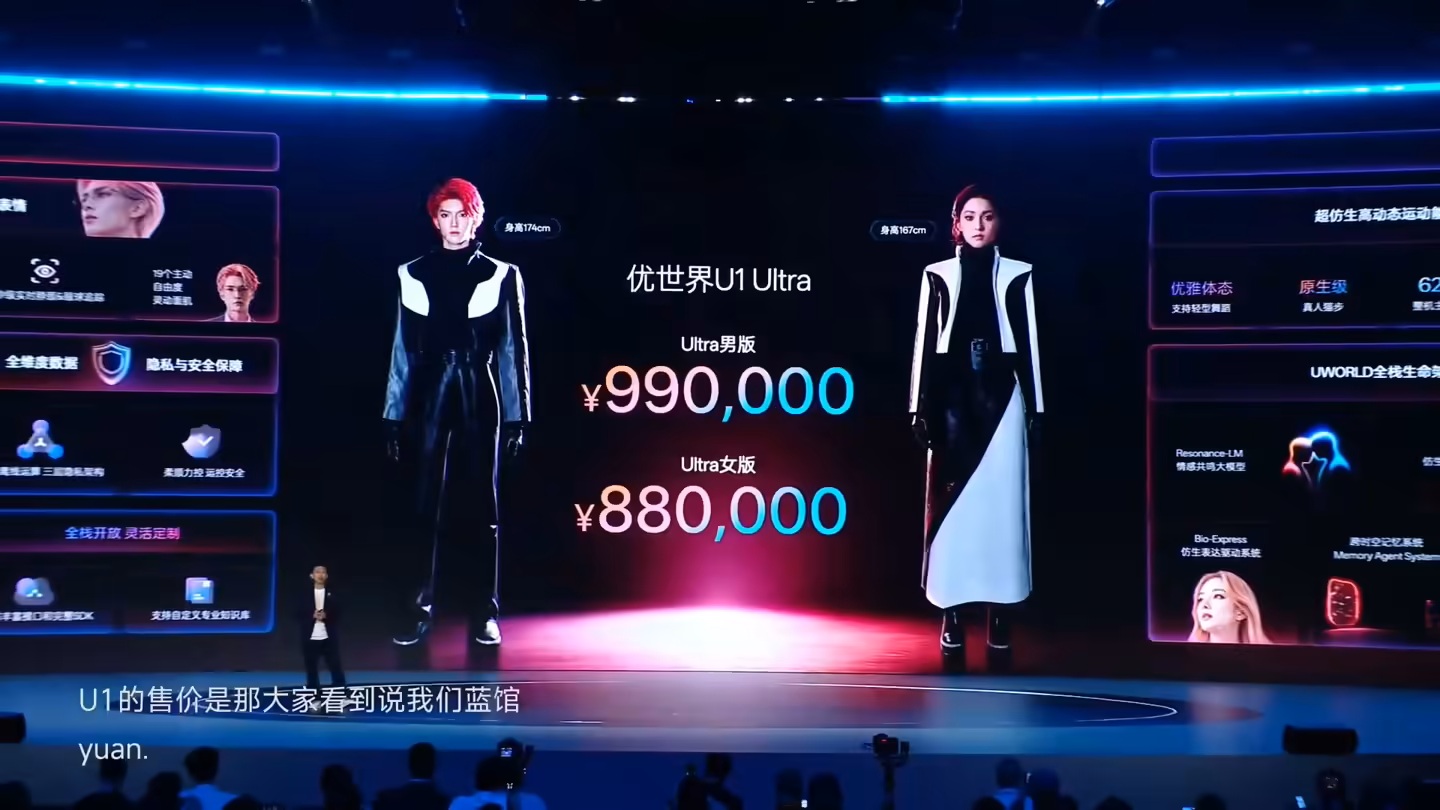
UBTECH Launches ‘U1’? Recent industry reports from mid-2026 indicate a structural transition in the consumer hardware landscape toward physical agentic computing. A prominent example is the reported development of the ‘UWORLD U1’ series, which represents a highly customized class of full-size ultra-bionic companion robots. While entry-level configurations such as the semi-torso edition reportedly start at approximately 119,800 RMB, high-dynamic, full-body variants are expected to scale up to 990,000 RMB. For developer teams and product leads, this transition highlights a technical shift: as consumer devices evolve from screen-centric smartphones to multi-jointed physical companions running local large language models, secure runtime auditing and device verification must descend to the hardware level to prevent automated transaction fraud.
At a Glance
- Physical Embodiment: Industry materials suggest configurations featuring a high-degree-of-freedom bionic platform and a dual-pivot spine to replicate complex human kinematics.
- Edge-First Execution: The system is described as utilizing a localized emotion-aware model trained on dedicated hardware clusters to ensure private, on-device calculations.
- Coordination Security: Transitioning from traditional visual screen interfaces to autonomous program execution introduces serious vulnerabilities for cryptographic terminal authentication.

Physical and Execution Layers: The Transition to Embodied Systems
According to recent industry reports, the UWORLD U1 series represents an effort to transition bionic hardware from industrial automation into household companionship. This consumer lineup comprises several structural configurations engineered to mimic human characteristics. In this system setup, the entry-level U1 Lite semi-torso model starts at 119,800 RMB. In contrast, the full-body U1 Pro is priced at 169,800 RMB (approximately $25,000 USD), and the premium U1 Ultra, featuring advanced mobility and dual-gender skeletal structures, ranges up to 990,000 RMB. The corporate expansion indicates that UBTECH is transitioning from a traditional B2B industrial robotics manufacturer to an AI-enabled consumer platform, leveraging its pre-existing Walker S production lines to scale consumer delivery.

This corporate development aligns with a growing demand in the global loneliness economy. Market tracking data suggests that the consumer bionic sector may conceptually expand into a multi-billion-dollar market over the next decade. To target this segment, companion systems focus entirely on emotional support, lifestyle enhancement, and social assistance, rather than traditional household chores like cooking or cleaning. Under this strategic alignment, the hardware is engineered to mimic human features, featuring bionic skin, detailed fingerprints, and realistic micro-movements to establish trust during long-term interactions.

The Protocol Breakdown: How Non-Visual Runtimes Bypass Client-Side State
Unlike traditional smart-device ecosystems that rely on visual screen rendering, 3D companion robots communicate headlessly through voiceprint recognition, environmental awareness, and real-time physical telemetry. From the perspective of runtime governance, this changes the entire request chain.
When an on-device proactive care engine triggers S2S API calls, it bypasses the standard client-side browser cookie context and manual touch input. The system processes requests through an Agent Memory OS. Headless routing often isolates the session from the client-side system. Traditional browser-based attribution methods may no longer capture the complete user journey because they rely on browser cookies to link the initial click to the installation. Under these conditions, the attribution accuracy decreases significantly across the communication stack.
Visual Client Flow:
User Web Action -> Browser Window (Cookies, LocalStorage) -> App Store -> App Installed (Attributed)
Physical Agent Flow: Contextual Sensor Cue -> On-Device Local LLM -> Non-Visual API Call -> S2S Webhook Execution

Architectural Implications: Session Persistence and Local Parameter Recovery
In practice, engineering teams usually choose between building an internal cost verification framework, deploying self-hosted API gateways, or adopting pre-built SDK solutions. Developing a proprietary system requires substantial engineering overhead. Teams must build custom server-side databases, maintain execution state libraries, and continuously update logic to comply with evolving OS security standards. For many organizations, the maintenance cost of an in-house tracker is high.
Alternatively, developers generally evaluate several approaches to monitor runtime execution without relying entirely on cloud-side metrics:
- Local Model Deployments: Running small, highly specialized open-source models inside secure offline environments.
- Strict Firewall Sandboxing: Restricting active development containers from establishing external outbound network connections.
- Enterprise MMPs: Utilizing robust third-party mobile measurement platforms for deep-linking workflows.
- Specialized Parameter SDKs: Deploying dedicated integration utilities for precise, cost-sensitive custom parameter pass-through.
Developer Environment Setup Comparison
| Execution Strategy | Token Cost Exposure | Heuristic Match Accuracy | Compliance Verification |
|---|---|---|---|
| Direct API Calls | ⚠️ High (100% On-Demand) | ❌ None | Low (Potential Fraud) |
| Custom Token Proxy | ✅ Managed Limits | 🔄 Medium | High (Heavy Backend Overhead) |
| Cache-Aware SDK | ✅ Managed Limits | ✅ High | High (Frictionless Setup) |
Robot Context Created -> Register Local Hardware State on Secure Central Server
                                         |
Autonomous API Call -> Bind Session Variable (Local Hardware Enclave Hash)
                                         |
App launches on device -> SDK query to central state database -> Restore Context parameters
Although this research focuses on physical robot companion architecture rather than attribution, mobile developers often face another engineering challenge once users transition from web pages to installed applications. In those scenarios, server-side parameter recovery platforms such as Branch, AppsFlyer, Adjust, and OpenInstall preserve installation context independently of browser sessions. These systems maintain server-side parameters before installation and restore parameters when the app first launches, reducing the reliance on client-side browser session persistence. And as UBTECH Launches ‘U1’ to bring bionics to the consumer market, developers face the choice of utilizing these integrated libraries.
Engineering Recommendations
Bionic Companion Integration Checklist
To ensure reliable parameter flow and protect your local database integrations before deploying automated workflows on UWORLD platforms, engineering teams should focus on the following parameters:
- Contextual Path Verification: Audit how the Agent Memory OS maps transaction metadata during asynchronous companion queries to ensure deep-link survival.
- Biometric Identity Preservation: Map local voiceprint and 3D facial credentials to cryptographic session tokens for secure S2S API execution.
- Local Data Sandboxing: Ensure all interactive telemetry and conversation history are locked inside the local-first storage layers, meeting strict privacy standards.
- Low-Latency Speech Alignment: Tune the voice-to-lip controller sync to keep speech latency below the 20ms threshold to prevent user interaction fatigue.
- Proactive Care Routing: Establish non-intrusive triggers for the proactive care engine, preventing the system from generating redundant, unprompted webhooks.
Frequently Asked Questions (FAQ)
Why is there a strategic shift toward emotional companionship in consumer robotics?
According to UBTECH’s launch briefing, the industrial and commercial sectors are rapidly experiencing hardware standardization. Conversely, the household and elder-care markets present vast, unexploited long-tail opportunities, where providing personalized, low-latency emotional companion services yields significant economic value.
How does the local-first three-layer privacy architecture work?
Based on UWORLD’s engineering specifications, the system implements a strict compliance sandbox. It processes interactive voice, facial, and contextual data locally on-device via the Huawei Ascend framework. Minimal cloud calls are encrypted, and users retain hardware-level shutoff controls to prevent unprompted data uploads.
How can parameter persistence survive in bionic device environments?
Traditional on-device session parameters can become fragmented when interactions execute across isolated operating system sandboxes or voice-driven controllers. To ensure session continuity during application launching, software teams implement server-side parameter state management and session matching. This approach binds session variables to secure hardware identifiers on a central server, allowing the client-side SDK to retrieve the context asynchronously on first launch.
The Core System Insight
The real shift is not model size, but execution context becoming non-visual and autonomous. As software interactions migrate from 2D graphical user interfaces to headless, agentic, and bionic ecosystems, the traditional concept of a “user session” is undergoing a profound transformation. In these non-visual environments, transactions and computations execute in the background via automated state networks and device-level sandboxes, where client-side browser cookies and visual handshakes no longer exist.
Key Takeaways for Engineering Teams
The transition of physical AI into mass production signals a broader shift toward network-native programmatic communication. As applications increasingly communicate through automated data exchanges rather than human-rendered layouts, engineering teams must re-evaluate traditional integration strategies. Platforms that depend heavily on manual, visual user actions may face structural gaps when automated agents manage the request pipeline. Transitioning to server-side attribution and secure parameter pass-through represents a highly probable direction for maintaining reliable tracking and security coverage.
This transition suggests a fundamental rewrite of our measurement frameworks and security protocols. Future attribution systems are likely to rely more heavily on server-side identity matching and secure state synchronization. As more AI agents begin acting as the first consumer of digital communication, attribution architectures will increasingly depend on server-side identity, deferred state recovery, and protocol-level context preservation rather than browser sessions alone.