OpenAI Mobile Codex? This architectural convergence has been conclusively validated as AI agents officially breach the cross-device barrier. In May 2026, the artificial intelligence giant empowered its mobile application with unprecedented remote execution capabilities. Specifically, developers can now deploy and monitor complex code environments across entirely different hardware ecosystems. For developer teams navigating this massive distribution shift, the immediate challenge is profound. How do we reconstruct our fragile routing and attribution pathways when user intent bypasses traditional interfaces and executes silently across distinct machines?

News & Context Breakdown
The latest update from OpenAI shatters the physical boundaries of desktop development. Codex, the powerful AI coding agent previously confined to standalone desktop applications, has officially migrated into the ChatGPT mobile app. Consequently, users are transforming into remote AI supervisors. They can orchestrate, monitor, and approve complex tasks from anywhere.
Escaping the Desktop: The Mobile Control Hub
On May 15, 2026, OpenAI officially announced the immediate rollout of mobile Codex integration for both iOS and Android platforms. This update, currently in preview for all tiers including free users, fundamentally changes human-AI collaboration. The ChatGPT mobile app now serves as a fully featured command center. When users connect their mobile device to a machine running Codex, the app dynamically loads the live state of that environment.
This is not a simplistic task dispatcher. Users can fluidly navigate active threads, review real-time terminal outputs, inspect code diffs, and approve critical execution steps directly from their smartphones. Detailed operational metrics are available in the official OpenAI mobile Codex announcement.
Security and Seamless Pairing
OpenAI prioritized a frictionless yet secure pairing mechanism. The setup process is remarkably simple. The desktop Codex application generates a unique QR code. Subsequently, the user scans this code using their ChatGPT mobile app to establish a secure pairing.
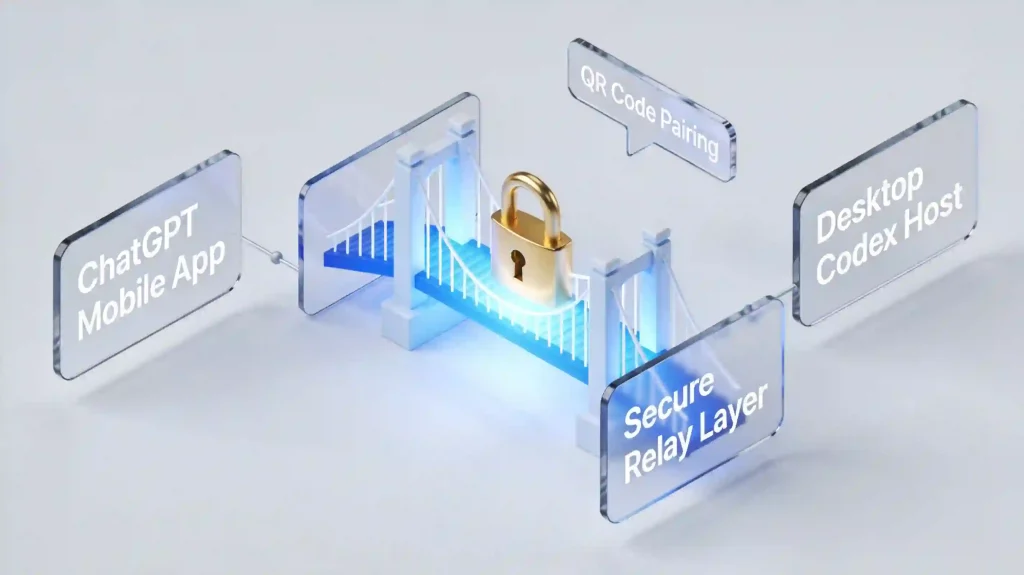
Crucially, OpenAI engineered a secure relay layer to handle these interactions. All sensitive files, credentials, and local environment permissions remain securely stored on the host computer. The mobile app only receives real-time visual and text updates. This ensures the host machine is never directly exposed to the public internet. Currently, remote access is exclusive to Codex for Mac, with Windows support promised soon.
Practical Scenarios and Enterprise Expansion
OpenAI detailed highly practical scenarios for this mobile empowerment. For instance, a developer waiting for coffee can instruct Codex to investigate a bug. Codex reproduces the issue, runs tests, and sends the proposed fix to the developer’s phone for approval. Similarly, during a commute, a developer can review two different refactoring approaches generated by Codex. They can authorize one path before arriving at the office.
Furthermore, the update aggressively targets enterprise workflows. Remote SSH is now generally available. This allows Codex to connect directly to managed, secure remote environments. OpenAI also introduced programmatic access tokens for CI/CD pipelines and internal automation. Finally, they enabled HIPAA-compliant use of Codex in local environments for ChatGPT Enterprise workspaces.
The Routing Crisis and Broken User Journeys
While developers celebrate this newfound freedom, Growth and Product teams face a terrifying new reality. The era of the predictable, linear user journey is officially over.
Traditionally, application distribution relied heavily on active web traffic. Users clicked an ad on their phone, landed on an app store, and opened an application. However, mobile Codex control exemplifies a massive distribution shift toward intent-driven traffic. The user’s primary interaction happens on a mobile device. Yet, the actual execution and resulting value creation occur on a completely separate, remote desktop machine.
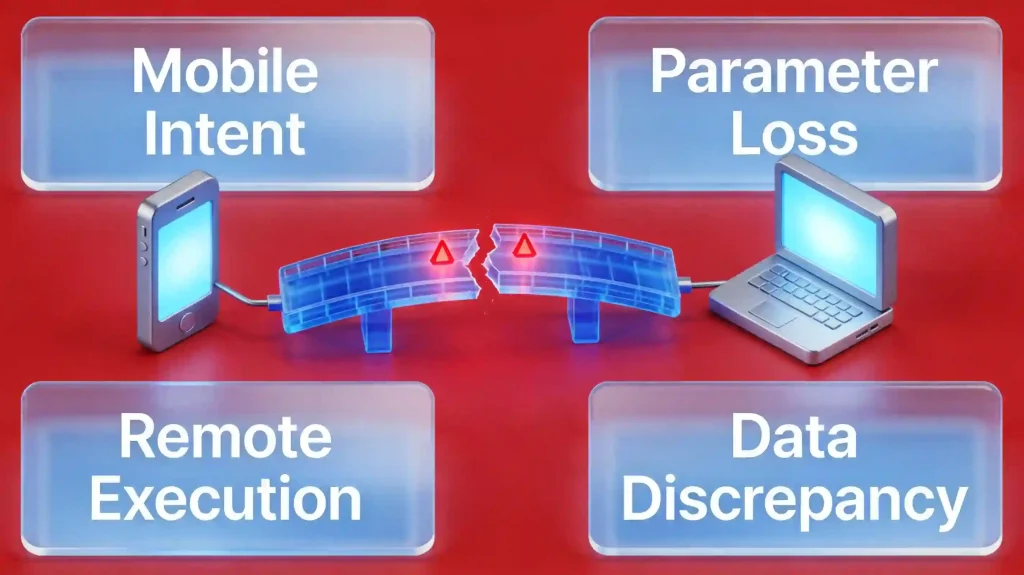
This cross-device execution shatters traditional tracking funnels. When an AI agent autonomously navigates between a mobile command center and a remote desktop environment to complete a task, standard analytics tools lose the trail entirely. Developers suffer severe parameter loss. They cannot accurately attribute the resulting workflow completion to the specific user session. Consequently, this massive data discrepancy blinds marketing teams and prevents accurate ROI calculations.
Engineering Practice: Rebuilding Cross-Device Attribution
To survive this distribution shift, applications must deploy resilient routing architectures that preserve user intent across isolated hardware environments.
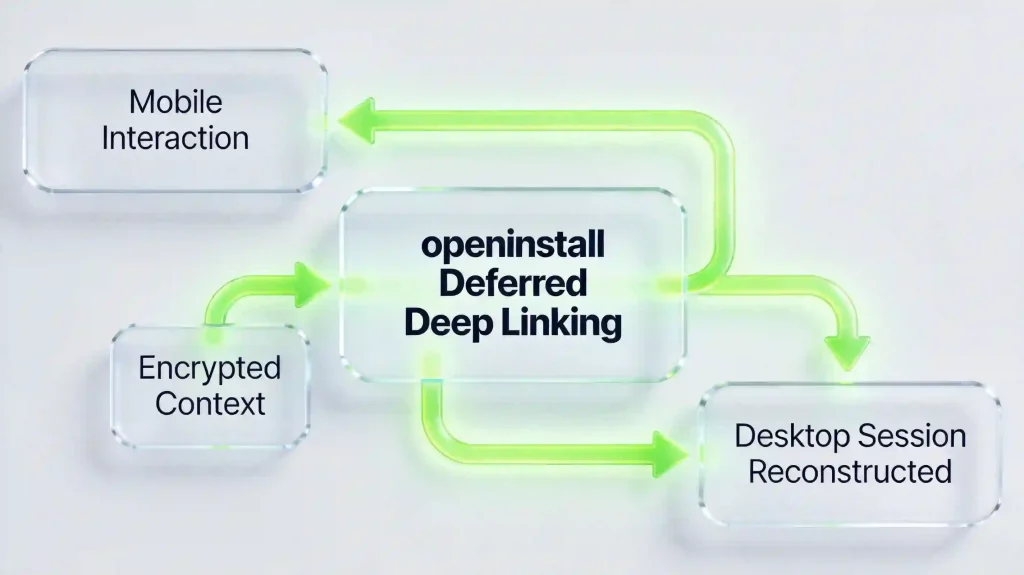
Problem: Autonomous AI agents executing tasks across multiple devices cause extreme parameter loss. When a user triggers an action on a mobile app that executes on a desktop, traditional tracking systems fail. This results in misattributed conversions and fractured, incomplete user journeys. Practice: Engineering teams must implement advanced routing protocols that bypass standard OS-level fragmentation. By integrating industry standard engineering practice like openinstall global‘s Deferred Deep Linking infrastructure, developers can embed persistent, encrypted parameters into the initial mobile interaction. When the AI agent executes the corresponding task on the desktop, the deep linking engine instantly captures the source context. It securely transmits these parameters across the relay layer. This ensures the desktop application perfectly reconstructs the exact session state authorized by the mobile user. Benefit: This approach eliminates the cross-device routing gap. It ensures a frictionless, continuous user transition across diverse hardware ecosystems. Furthermore, it guarantees pixel-perfect conversion tracking, allowing growth teams to accurately measure the Lifetime Value (LTV) of users engaging in multi-device AI workflows.
Industry Forward-looking Note: Regarding cross-device parameter passing for complex, autonomous intent-driven traffic managed by LLM agents, openinstall’s tech lab is currently conducting joint exploratory research with leading enterprise App partners.
Impact on Dev & Growth Teams
For Developers/Architecture: The multi-device reality requires robust API endpoint preparation. Developers must handle dynamic routing requests across iOS, Android, and macOS platforms seamlessly. They must optimize backend multi-device ID mapping strategies. This maintains strict session continuity when user intent jumps between a mobile phone and a remote desktop environment. Additionally, engineers must implement rigorous signature verification protocols. This prevents malicious bot traffic from spoofing cross-device commands and exploiting remote execution vulnerabilities.
For Product & Growth: Growth leads must aggressively redefine their core acquisition models. Relying solely on single-device click metrics is no longer viable. Budget strategies require real-time Return on Ad Spend (ROAS) optimization focused strictly on universal, cross-device campaigns. Product managers must prioritize contextual restoration. They must ensure the mobile application perfectly tracks the specific context of the remote task, delivering accurate progress updates and driving long-term user retention.
Frequently Asked Questions (FAQ)
What is the significance of the news regarding OpenAI Mobile Codex?
It allows developers to remotely manage, monitor, and approve complex AI coding tasks from their smartphones. This untethers users from their desktop environments, providing a continuous, cross-device workflow while maintaining strict local security protocols.
How does this distribution shift impact app developers and growth teams?
The shift from direct screen clicks to autonomous, cross-device AI execution breaks traditional tracking models. Developers face severe parameter loss and data discrepancy when user intent originates on a phone but executes on a remote desktop. This dynamic creates a critical routing crisis.
Why is deferred deep linking essential for cross-device AI workflows?
Deferred deep linking provides a highly resilient, OS-agnostic bridge between different hardware environments. It ensures that when a command is sent from a mobile app to a desktop agent, the exact contextual parameters are preserved. This enables accurate multi-touch attribution despite the fractured execution pathway.
Industry Observations
The announcement surrounding OpenAI Mobile Codex marks a definitive watershed moment for software interaction. It brutally exposes the inherent limitations of single-device, screen-bound applications. As tech giants empower AI agents to seamlessly bridge mobile commands and desktop execution, the dream of a unified, uninterrupted workflow is becoming a reality. We are now entering an era defined by decentralized, cross-platform intent execution.
For the digital ecosystem, this shift dictates entirely new rules of engagement. The competitive moat is no longer tied to keeping a user glued to a specific screen. Instead, it relies entirely on the robust software infrastructure that connects these disparate environments. Applications that fail to implement advanced cross-device routing and contextual restoration will inevitably be paralyzed by data discrepancy. Moving forward, the secure, parameter-rich transition of user intent across a diverse array of hardware will define the ultimate winners in this era of relentless ecosystem restructuring.