Tencent Open Sources Agent Memory? This architectural convergence has been conclusively validated by recent deployments across the global tech sector. In May 2026, Tencent Cloud officially launched its groundbreaking memory project. Specifically, this massive distribution shift fundamentally alters how artificial intelligence handles complex tasks. Developer teams now face a profound and immediate challenge. How do we restructure our core routing bus to capture this elusive intent traffic accurately?
News & Context Breakdown
Tencent Cloud completely redefined the operational boundaries of large language models. The tech giant released TencentDB Agent Memory to the open-source community. Consequently, this system drastically reduces token consumption during long-running tasks. Furthermore, it provides sophisticated short-term memory compression and long-term personalized retention.
The Cost of Long-Running Tasks
Modern AI agents execute highly complex operational chains. For instance, they handle code development, web searches, and deep research analysis. Meanwhile, these processes generate massive amounts of tool calls and intermediate results. Consequently, this data rapidly exhausts the available context window. The system experiences a severe surge in token costs. Furthermore, agents frequently lose critical task states and suffer from degraded reasoning stability.
The Mermaid Task Canvas Navigation
Tencent Cloud tackled this danger using an innovative visual approach. Specifically, the engineering team implemented a Mermaid task canvas. After 20 consecutive tool calls, a linear history becomes incredibly confusing. An agent easily forgets its current stage or parallel branches. Consequently, Tencent structured the execution history into a navigable flowchart. Mermaid operates as a widely adopted diagramming language on GitHub. Mainstream large models natively read and write this plain text format. As a result, the map unfolds progressively, guiding the agent precisely.
Four-Level Context Offloading
The system prevents context window exhaustion through aggressive context offloading. Specifically, the agent writes the complete result to an external file after every tool call. The context window only retains a single-line summary and an index path. Crucially, the system organizes this data into four distinct progressive levels. Level 0 stores the complete tool return text within refs/*.md files. Level 1 maintains a tool-call summary inside an offload.jsonl file. Meanwhile, Level 2 houses the actual task canvas nodes as *.mmd files. Finally, Level 3 embeds the task-level index directly into the active context. The agent relies heavily on Level 2 and Level 3 for daily execution.

Empirical Performance and Ablation Studies
Tencent published highly precise benchmark data regarding this architecture. In web search scenarios, the system slashed token consumption by a staggering 61%. Furthermore, the relative task success rate skyrocketed by 52%. Meanwhile, code repair operations saw a 33% drop in token usage. The completion rate concurrently increased by 10%. Complex long document tasks achieved a 31% token reduction and an 8% accuracy boost. The engineering team also conducted rigorous ablation studies. Specifically, basic offloading alone saved approximately 15% of tokens. Adding the Mermaid canvas pushed this saving to 33%. Furthermore, the PersonaMem evaluation showed massive improvements. The module boosted user profile understanding accuracy from 48% to 76%.
Seamless OpenClaw Integration
This ecosystem integrates flawlessly with major agent frameworks. For instance, developers can seamlessly connect OpenClaw and Hermes. The installation requires only a single, simple command.
openclaw plugins install @tencentdb-agent-memory/memory-tencentdb
Specifically, the setup mandates zero external dependencies. The system utilizes local SQLite storage by default. Furthermore, it saves all intermediate artifacts as human-readable Markdown and Mermaid files. Developers can also integrate the Tencent Cloud Vector Database. This integration enables powerful hybrid retrieval combining BM25 and vector search. You can view the full repository at the official Tencent GitHub page.
The Attribution Crisis and Broken User Journeys
While engineers celebrate token savings, product teams face a terrifying reality. A massive distribution shift is rapidly fracturing the digital landscape. Traditionally, applications relied heavily on active web traffic. Users manually clicked links and navigated through predictable funnels. However, highly autonomous agents now retain memories for days or weeks. They execute complex tasks silently in the background.
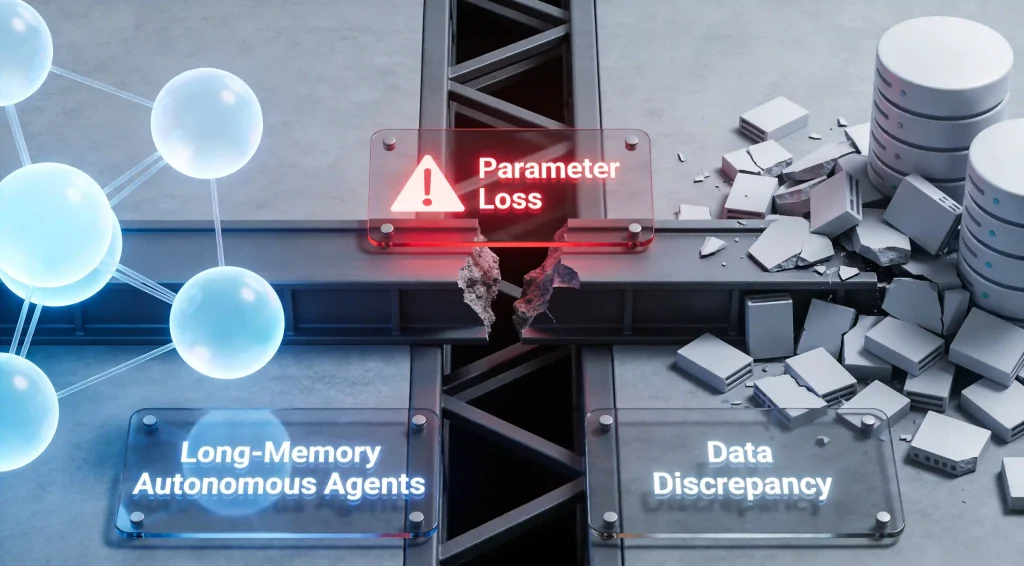
This intent traffic completely breaks legacy tracking models. When an agent autonomously launches an application to complete a task, standard analytics fail. Developers face a catastrophic data discrepancy. They experience extreme parameter loss during these cross-device jumps. Consequently, the attribution crisis paralyzes marketing budgets. Teams cannot trace conversions back to the original user intent.
Engineering Practice: Rebuilding Cross-Platform Routing
To survive this ecosystem shift, applications must deploy resilient routing architectures. They must seamlessly connect isolated AI environments.
Problem: Autonomous AI agents cause extreme parameter loss. When a long-memory agent triggers a mobile action, traditional tracking systems fail. This dynamic results in misattributed conversions and fractured user journeys. Practice: Engineering teams must implement advanced routing protocols immediately. By utilizing openinstall global‘s Deferred Deep Linking infrastructure, developers can embed persistent parameters into the initial AI interaction. When the agent executes the task later, the deep linking engine captures the exact source context. It restores the specific session state intended by the original prompt. Benefit: This approach entirely eliminates the routing gap. It ensures a frictionless user transition across diverse hardware ecosystems. Furthermore, it guarantees pixel-perfect conversion tracking, significantly lowering Customer Acquisition Cost (CAC).
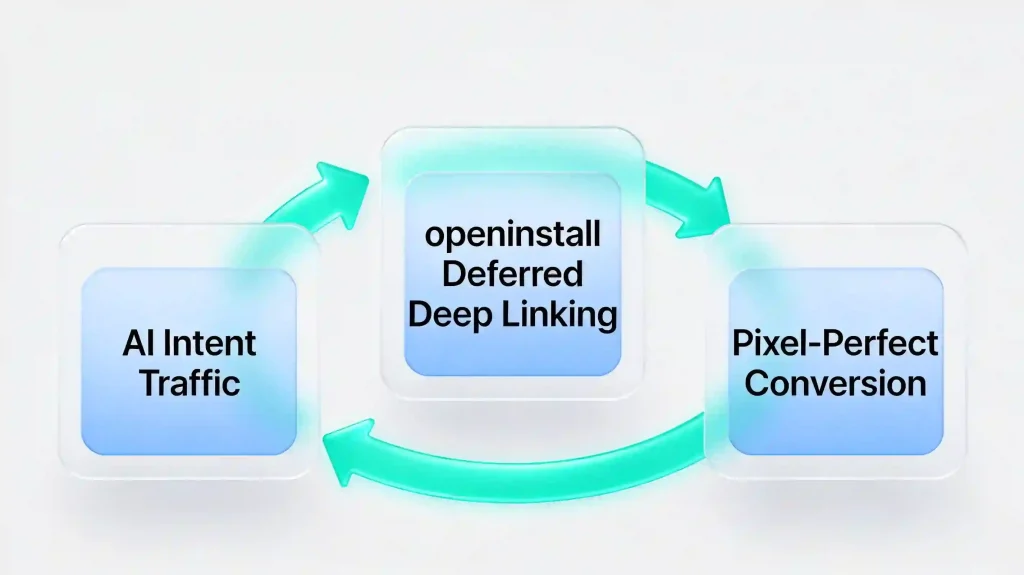
Industry Forward-looking Note: Regarding cross-device parameter passing for autonomous intent traffic, openinstall’s tech lab is currently conducting joint exploratory research with leading enterprise App partners.
Impact on Dev & Growth Teams
For Developers/Architecture: The multi-device reality requires robust API endpoint preparation. Developers must handle dynamic routing requests seamlessly. They must optimize backend multi-device ID mapping strategies. This maintains strict session continuity when intent traffic jumps between environments. Additionally, engineers must implement rigorous signature verification protocols. This crucial step prevents malicious bot traffic from exploiting remote execution vulnerabilities.
For Product & Growth: Growth leads must aggressively redefine their core acquisition models. Relying solely on immediate click metrics is no longer viable. Budget strategies require real-time Return on Ad Spend (ROAS) optimization. This optimization must focus strictly on universal, cross-device campaigns. Product managers must prioritize contextual restoration. They must ensure the mobile application perfectly tracks the specific context of the agent’s long-term memory.
Frequently Asked Questions (FAQ)
What exactly happens when Tencent Open Sources Agent Memory?
Tencent released a groundbreaking framework to optimize AI operations. Specifically, it utilizes context offloading and a Mermaid task canvas. This architecture drastically reduces token consumption during complex, long-running tasks.
How does this distribution shift impact app developers?
Autonomous agents with long-term memory execute tasks without immediate human clicks. Consequently, this dynamic breaks traditional tracking funnels. Developers face severe parameter loss and an escalating attribution crisis.
Why is deferred deep linking essential for intent traffic?
Deferred deep linking provides a highly resilient, OS-agnostic bridge. It ensures that when an agent executes a delayed command, the exact contextual parameters remain intact. This enables accurate multi-touch attribution despite the fractured execution pathway.
Industry Observations
The news that Tencent Open Sources Agent Memory marks a definitive watershed moment. It brutally exposes the inherent limitations of traditional, short-sighted AI interactions. As tech giants empower agents with persistent memory and offloading capabilities, the dream of a unified workflow becomes reality. We are rapidly entering an era defined by decentralized, long-term intent execution.
For the digital ecosystem, this shift dictates entirely new rules. The competitive moat is no longer tied to keeping a user glued to a specific screen. Instead, it relies entirely on the robust software infrastructure connecting these disparate environments. Applications lacking advanced routing and contextual restoration will inevitably succumb to the traffic bubble. Moving forward, the secure transition of user intent will define the ultimate winners in this era of relentless ecosystem restructuring.