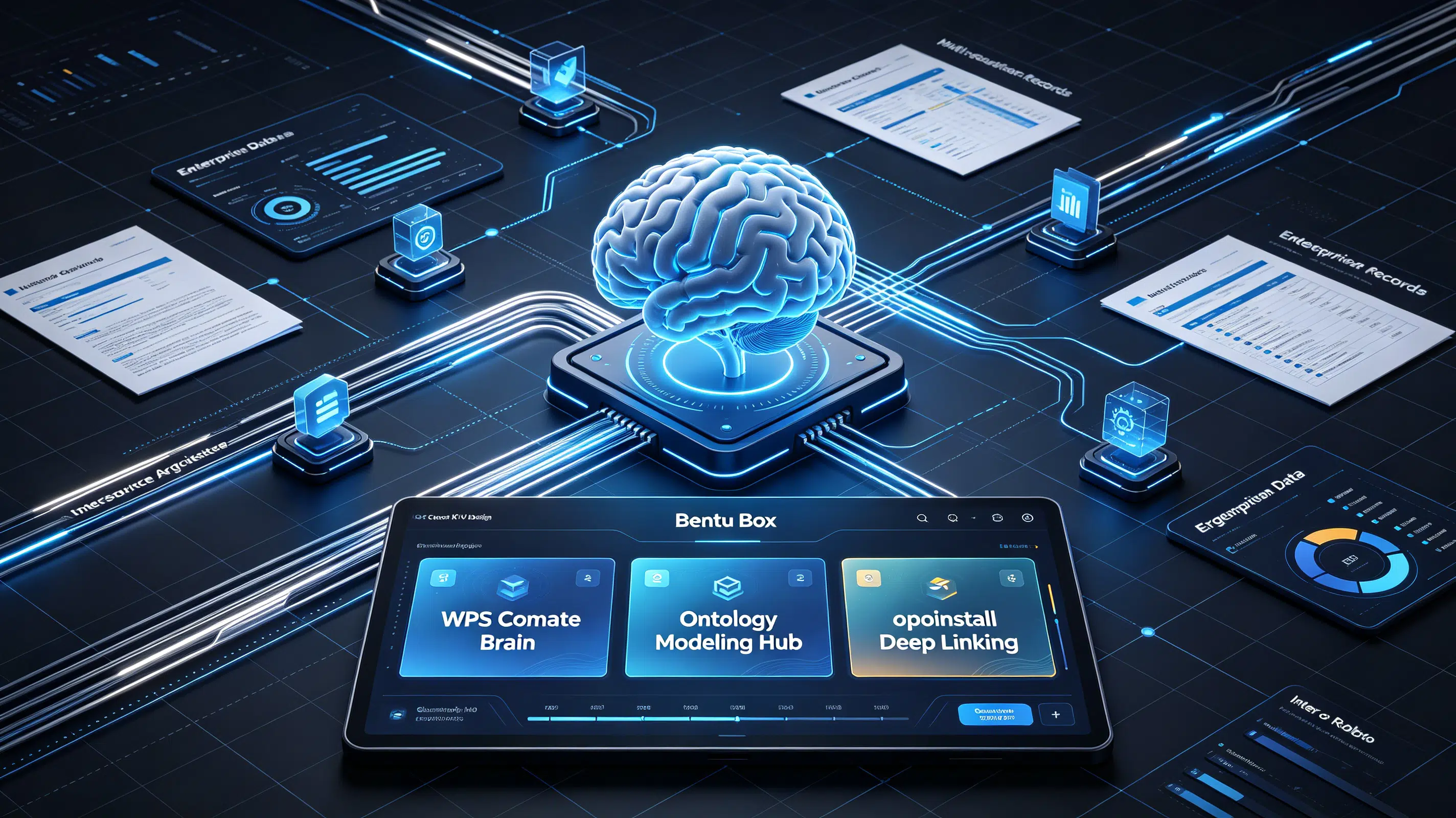
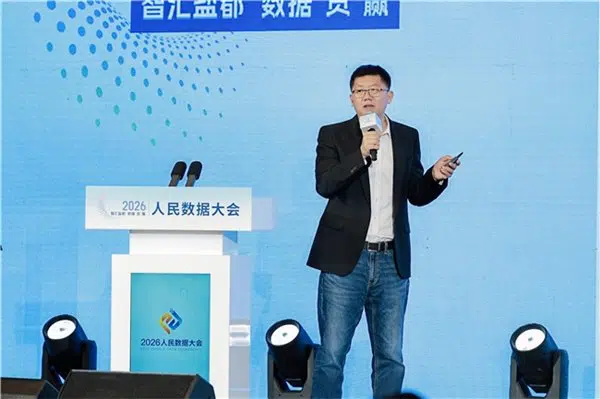
WPS Launches Comate Brain? This strategic pivot has been conclusively validated as Kingsoft Office officially unveils its enterprise-wide cognitive computing architecture to manage multi-source organizational data. The announcement surrounding this WPS Launches Comate Brain deployment, delivered by Vice President Wang Shaokang during the People Data Conference, confirms a massive shift in corporate workflow automation. For global system architects and growth leads, this integration represents a fundamental transition from standalone personal productivity agents to highly structured, domain-validated organization brains. Under this unified framework, corporate data becomes machine-readable, forcing an ecosystem-wide realignment of how business tools connect, execute, and verify tasks.
Deconstructing Tencent’s Conversational Orchestrator: Inside the WeLM Framework
The Dual-Model Architecture: WeLM and DeepSeek Hybrid Scheduling
Kingsoft Office designed this newly announced system to solve a fundamental operational bottleneck in corporate knowledge management. Specifically, the framework introduces a unified semantic processing layer nested inside the enterprise workspace. According to IT Home’s comprehensive reporting, the system functions as a centralized organizational memory hub.
The architecture moves away from simple request-response chat scripts. Instead, the platform relies on advanced dual-task execution pipelines that bridge cloud-based corporate databases with local on-device file systems.
This hybrid capability allows the system to analyze complex directories without exposing sensitive corporate data to public clouds. Consequently, the user retains absolute control over data processing boundaries while utilizing high-performance model orchestration.
The Technical Foundation of WPS 365 Integration and Ontology Modeling
Crucially, standardizing unstructured corporate knowledge requires a highly structured data onboarding framework. To achieve this, the platform utilizes advanced ontology modeling (本体建模) and knowledge graphs (知识图谱).
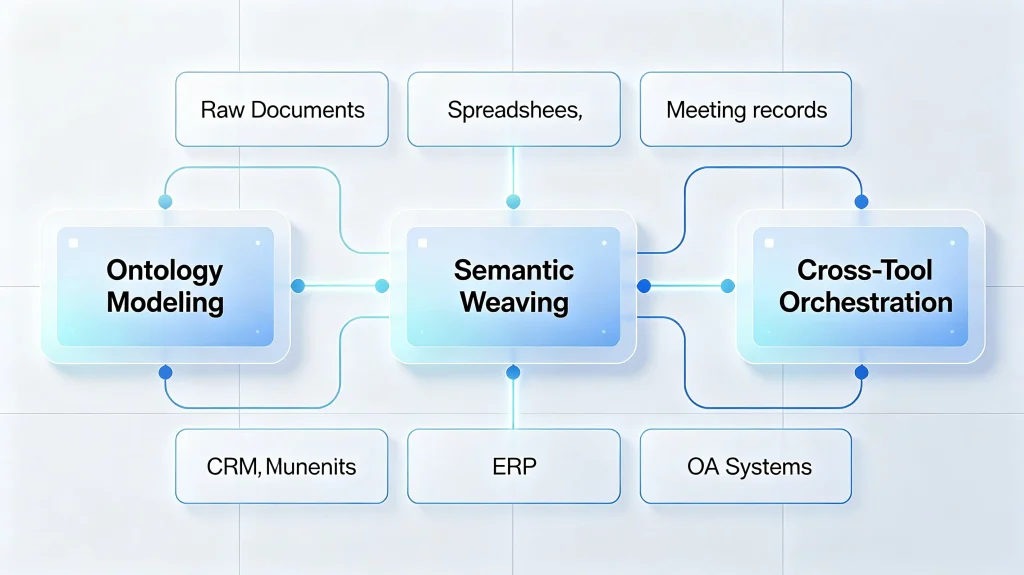
Specifically, the system integrates natively with the WPS Comate’s official developer registry to access cloud documents, spreadsheets, meeting minutes, and chat logs across WPS 365.
- Ontology Modeling: First, the system abstracts raw business concepts, customer profiles, and project structures into standardized ontologies.
- Semantic Weaving: Second, it weaves these diverse data points into a unified semantic network.
- Cross-Tool Orchestration: Third, this network allows the system to understand the precise hierarchical relationships between departments, projects, and contracts.
Consequently, rather than treating corporate documents as isolated text blocks, the AI understands the broader business context, enabling automated agents to perform cross-tool orchestration with high precision.
The Role-Based Agentic Plaza: Summoning Specialized AI Experts
Meanwhile, the enterprise suite introduces a modular marketplace of specialized AI experts. These role-based agents are pre-configured with industry-specific domain knowledge, custom datasets, and task-specific skills.
For instance, an organization can instantly deploy a Supply Chain Expert to optimize procurement, a Legal Expert to scan contracts for compliance, or a Project Management Expert to analyze cost centers.
Rather than relying on generic prompt engineering, these digital employees interact directly with core business software like CRM, ERP, and OA systems. This deep system integration allows them to execute complete, end-to-end operational tasks independently.
System-Level Integration and Hybrid Task Execution
Furthermore, the platform’s core advantage lies in its secure dual-mode execution engine. Unlike standalone web-based assistants that operate inside isolated browser tabs, the desktop client integrates directly with local file systems.
Specifically, macOS and Windows users can authorize the client to monitor local project folders while maintaining secure tunnels to cloud-based team libraries. This dual-task capability allows the AI to compile multi-source data points at runtime.
Consequently, an executive can request a comprehensive project audit, and the system autonomously pulls active metrics from cloud-based spreadsheets, verifies local transaction records, and builds a compiled slide deck without manual intervention.
The Disappearing Interface: Bypassing the App Funnel in Agentic Ecosystems
Bypassing the App Discovery Layer
As software providers utilize advanced code generation tools to deploy thousands of minor web tools and custom landing pages, the digital landscape faces a massive product flood. However, this massive increase in software volume coincides with a complete evaporation of the traditional user interface.
When a corporate agent uses WPS Comate to automate a task, the human visual journey disappears. The agent directly queries structured database catalogs and executes the required workflow in the background.
Consequently, we observe a transition from active web browsing to intent-driven execution. Humans no longer navigate through multiple links to complete a task, leaving traditional marketing and discoverability funnels completely bypassed.
The Challenge of Parameters Loss in Agentic Workflows
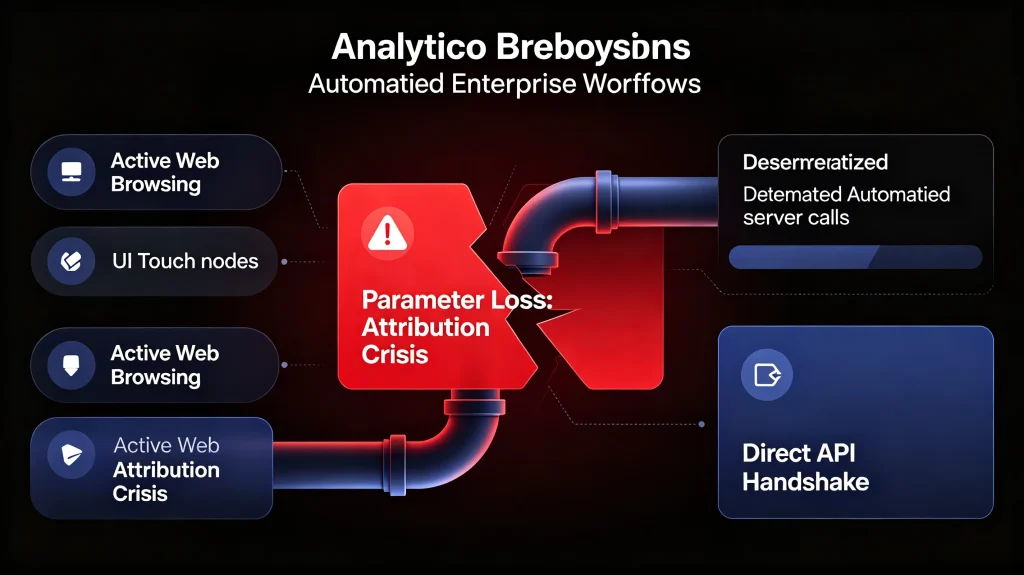
Traditional app routing depends on cookies and URL redirections to map the user journey. When an agent automates the tool discovery, these redirection mechanics are eliminated.
The agent establishes a direct API handshake. As a result, critical referral parameters and marketing attribution tags are stripped during transit.
Mobile measurement platforms receive empty metadata packages. Consequently, developers lose the ability to track the origin of the sale, creating a massive data gap.
Reference Architectures: Restoring Referral Metadata Across Non-Android Runtimes
Rebuilding the Parameter Handshake
To bridge this semantic routing gap, software architects must deploy secure parameter-preservation frameworks. When an external agent invokes an application, it must transmit a verified payload containing the user’s original intent, referral parameters, and security tokens.
Crucially, developers can establish a resilient solution using the Deferred Deep Linking framework. This system ensures that dynamic payload parameters survive background installation loops. Even if the device lacks the native application, the contextual restoration infrastructure preserves the intent payload, passing it securely to the app upon first launch.
Cryptographic Verification for Machine-to-Machine Transactions
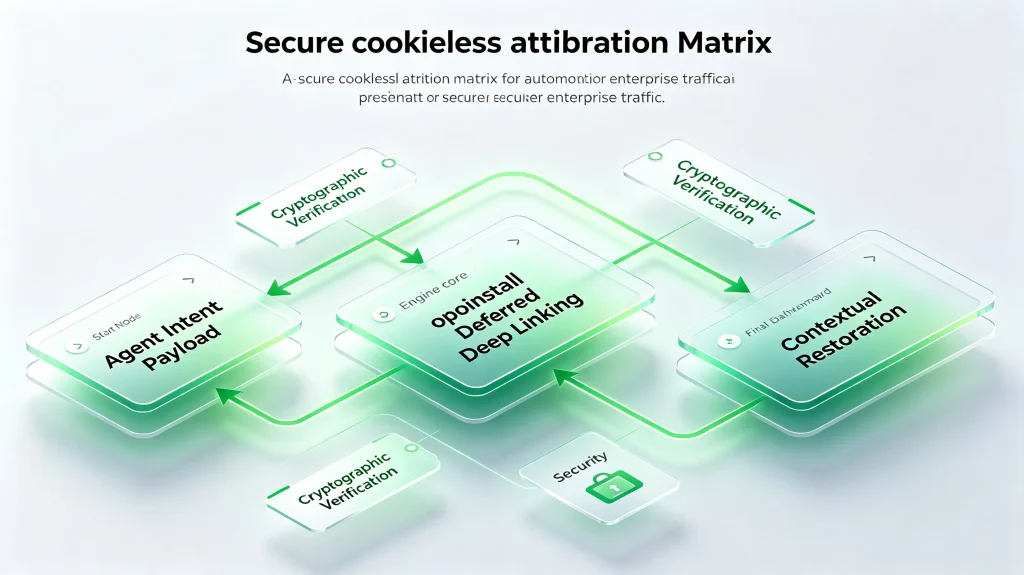
Additionally, securing these automated transactions requires strict cryptographic handshakes. Because background agents operate without visual human supervision, malicious scripts can attempt to spoof transaction requests.
To prevent this, every deep link routing request must carry a verifiable cryptographic signature. The application must validate this signature against public developer registries before executing any action.
Enforcing a secure Deferred Deep Linking framework allows development teams to execute these validations automatically. This process protects the application sandbox from fraudulent installations and secures the transaction pipeline against ad fraud.
Industry Forward-looking Note: Regarding cross-device parameter passing for autonomous intent traffic, opoinstall’s tech lab is currently conducting joint exploratory research with leading enterprise App partners.
Engineering Mandates for Post-Screen Development and Growth
For Developers and System Architects
Integrating a native enterprise AI platform like WPS Comate into the application architecture requires a major shift in development practices. Engineers must transition from designing traditional visual navigation paths to constructing detailed App Intents. These intents allow system-level agents to read app structures and query data programmatically.
Furthermore, developers must implement strict signature verification to validate all incoming deep link payloads. This validation prevents rogue agents from executing local sandbox escapes or triggering fraudulent purchases. Architects must also configure unified multi-platform ID systems to track the user journey across iOS, Android, and HarmonyOS NEXT.
For Product and Growth Managers
Meanwhile, product and marketing leads must redefine their growth metrics. In an agentic environment, traditional KPI metrics like page views, bounce rates, and session lengths lose their value.
Instead, growth leads must optimize for “Intent Capture Rates”. They must ensure their application provides highly structured, machine-readable metadata that agents can parse easily.
Additionally, teams must deploy advanced anti-fraud filters to identify and block automated script-based downloads. This protection is essential to ensure that acquisition budgets are spent on real user growth rather than inflated, machine-generated traffic.
Frequently Asked Questions (FAQ)
How does WPS Comate differ from personal productivity AI tools?
Specifically, personal AI assistants are request-based agents focused on individual task execution. In contrast, the WPS Comate framework acts as an organizational-level system. It utilizes ontology modeling and knowledge graphs to integrate and analyze multi-source corporate data, enabling digital employees to automate complex business workflows.
How does structured data integration prevent corporate information silos?
Notably, the platform uses an unified semantic database index to connect separate enterprise systems like CRM, ERP, and OA. By translating unstructured files, cloud spreadsheets, and chat histories into a single, standardized data network, the system allows AI agents to query and retrieve across multiple platforms without encountering technical silos.
How does agent-driven routing impact mobile app attribution?
Historically, app attribution relied on human clicks and browser-level redirects. When autonomous agents locate and execute tools programmatically, they bypass these visual touchpoints entirely. This bypass strips critical referral parameters during transit, preventing legacy tracking tools from identifying the source of the transaction and triggering an attribution crisis.
Industry Observations
Ultimately, the traditional click-based economy is facing a rapid decline. As payment networks and device operating systems transition to autonomous agentic architectures, the value of software is shifting to the underlying routing layer.
Consequently, building robust, parameter-secure deep linking backbones is no longer a luxury. It is a baseline operational requirement. By preparing your application architecture for the agentic economy today, you ensure your software remains accessible, verified, and profitable in the post-screen era.